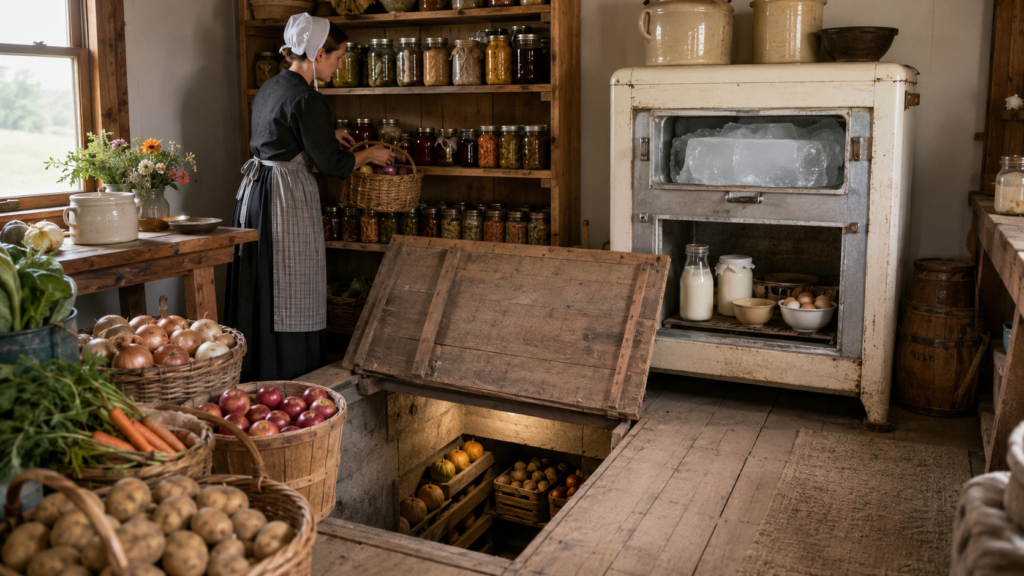
Most of us do not think about refrigeration until the power goes out.
The refrigerator hums in the kitchen, the freezer keeps meat solid, the walk-in cooler protects restaurant inventory, and the supermarket display case keeps milk, produce, beverages, and prepared foods safe for customers. Modern refrigeration is so normal that cold storage feels automatic.
But for many Amish families, especially in more conservative communities, daily life is built around a different question: how do you keep food cold without depending on electricity from the public grid?
The answer is more interesting than most people expect. Amish food storage is not based on one single trick. It is a practical system built from tradition, local rules, seasonal planning, natural cooling, alternative fuels, and careful food preservation. Depending on the Amish community, household, region, and church district, food may be kept cold with ice houses, root cellars, spring houses, propane refrigerators, gas-powered refrigeration, battery systems, rented freezer space, canning, pickling, drying, smoking, and disciplined meal planning.
In other words, the Amish approach to cold food storage is not primitive. It is intentional.
It also teaches an important lesson about refrigeration itself. Long before electric refrigerators became standard, people understood that food lasts longer when heat, moisture, sunlight, air movement, and microbial growth are controlled. Modern refrigeration uses compressors, refrigerants, evaporators, condensers, fans, thermostats, and insulation to do this with precision. Amish food storage uses many of the same principles, but often with less dependence on the electrical grid.
To understand how it works, we need to look at the difference between “keeping food cold” and “preserving food safely.” Those are related, but they are not exactly the same.
First, Not All Amish Communities Follow the Same Rules
Before explaining the methods, it is important to understand that “Amish” does not describe one identical lifestyle everywhere. Amish communities vary widely. Some are more conservative. Some are more progressive. Some allow propane refrigerators. Some may allow limited battery-powered devices. Some rely more heavily on ice, root cellars, and canning. Some businesses may use refrigeration systems that would not be used inside the home.
The rules are often shaped by the local church district and its Ordnung, which is the set of community guidelines that governs daily life. The central issue is usually not whether a tool is modern. The deeper question is whether the tool connects the household too strongly to the outside world, encourages individualism, changes the pace of family life, or weakens the community’s values.
That is why many Amish communities avoid public grid electricity in the home but may use alternative forms of energy for specific practical needs. A propane refrigerator, for example, may be acceptable in some places because it does not connect the home to the electric grid. A gas engine may power equipment in a shop. A battery may be used for certain limited functions. A business may have different practical arrangements than a private home.
So when people ask, “Do the Amish use refrigerators?” the honest answer is: sometimes, but not always the kind most Americans use.
Many Amish families do use refrigeration. They may simply use a refrigerator powered by propane, natural gas, or another off-grid method rather than a standard plug-in electric refrigerator.
Method 1: Ice Houses
One of the most traditional ways to keep food cold without electricity is the ice house.
An ice house is a storage building designed to hold large blocks of ice harvested during the winter. In cold regions, ice can be cut from ponds, lakes, or other frozen water sources. The blocks are then moved into an insulated structure and packed with insulating material such as sawdust or straw. The goal is to slow melting as much as possible so that the ice can last into warmer months.
This method may sound old-fashioned, but it is based on solid thermal logic. Ice absorbs heat as it melts. As long as enough ice remains, it can keep the surrounding storage area cool. The insulation slows heat transfer from the outside air. The thicker the ice blocks, the better the insulation, and the cooler the storage environment, the longer the system can work.
Ice houses were once common across America before mechanical refrigeration became widely available. Dairies, hotels, restaurants, households, and food businesses all depended on harvested ice. In that sense, Amish ice storage is not strange at all. It is a continuation of a system that once supported much of the country’s food supply.
For Amish households, ice may be used to cool perishable items or support an icebox. An icebox is essentially a non-electric refrigerator. Ice is placed in a compartment, and the cold air helps keep food cooler than room temperature. It does not offer the same precise control as a modern refrigerator, but it can extend the life of certain foods when used properly.
The weakness of ice storage is that it depends on climate, labor, storage conditions, and timing. If winters are not cold enough, harvesting ice becomes difficult. If the ice house is poorly insulated, the ice melts too quickly. If too much cold storage is needed, the system requires a large supply of ice.
Still, the concept is powerful: collect cold when nature provides it, store it carefully, and use it when heat returns.
Method 2: Root Cellars
Root cellars are one of the most important food storage methods used by people living without modern refrigeration.
A root cellar is a cool, dark, humid storage space, usually built underground, into a hillside, or in a basement. It uses the natural insulating power of the earth to keep temperatures more stable than the air above ground. Even when outdoor temperatures swing from hot afternoons to cold nights, the soil below the frost line changes temperature much more slowly.
This makes root cellars ideal for storing certain fruits and vegetables, especially root crops such as potatoes, carrots, beets, turnips, parsnips, and rutabagas. They can also be useful for cabbage, apples, winter squash, onions, and other crops, although different foods need different temperature and humidity conditions.
The basic science is simple. Produce continues to respire after harvest. It gives off heat, loses moisture, and slowly breaks down. Warm temperatures speed that process. Dry air causes shriveling. Light can trigger sprouting or quality loss in some crops. Poor ventilation can trap gases and moisture, leading to spoilage.
A good root cellar helps slow those processes by controlling four things:
Temperature, humidity, darkness, and airflow.
For many root vegetables, a cold and humid environment is ideal. For onions and garlic, cooler and drier storage is better. Apples should often be kept away from certain vegetables because they release ethylene gas, which can speed ripening and spoilage. Potatoes should be stored in darkness to prevent greening. Squash usually prefers warmer and drier conditions than many root crops.
This is why good root cellaring is not simply “put food underground.” It is a storage discipline. It requires knowing which foods can be stored together, which need separation, which need high humidity, which need dryness, and which should be checked regularly.
For Amish families, root cellars fit naturally into a lifestyle based on gardening, farming, seasonal food, and household production. Instead of buying everything week by week from a supermarket, a family can harvest in season and store food for winter.
Modern refrigeration uses electricity to create cold. A root cellar uses the earth to borrow stability.
Method 3: Spring Houses and Cold Water Storage
In some regions, another traditional method is the spring house.
A spring house is a small structure built over or near a natural spring. Because spring water often stays cool year-round, it can be used to help preserve foods like milk, butter, and other perishables for short periods. Containers may be placed in or near cold running water, allowing heat to transfer from the food into the water.
This method was widely used in rural America before electric refrigeration. A steady cold spring could be a valuable household resource. It was especially useful for dairy products because milk needed to be cooled quickly after milking.
A spring house is not the same as a refrigerator. It does not guarantee a precise 35°F to 40°F storage environment. Its effectiveness depends on the water temperature, flow rate, container type, outdoor conditions, and how long the food is stored. But as part of a broader food system, cold water storage can be useful.
This method also reveals something important about refrigeration: cold is not a product. Cold is the removal of heat.
Whether a compressor is moving refrigerant through a coil or a jar of milk is sitting in cold spring water, the goal is the same. Heat moves away from the food so the food stays cooler.
Method 4: Propane and Gas Refrigerators
Many people are surprised to learn that some Amish homes use refrigerators. They are not always electric refrigerators connected to the public grid. Instead, many are powered by propane or natural gas.
A propane refrigerator often uses absorption refrigeration rather than the same compressor-based system found in most standard household refrigerators. Instead of using an electric compressor to circulate refrigerant, an absorption system uses heat as the driving energy source. In simplified terms, a propane flame provides heat that helps move a refrigerant solution through the cooling cycle.
This kind of refrigeration is common in RVs, cabins, off-grid homes, and remote locations. It can keep food cold without plugging into the electrical grid. For Amish households that permit propane appliances, this can be a practical solution.
From a refrigeration perspective, propane refrigerators are fascinating because they prove that refrigeration does not always require electricity in the way people assume. What refrigeration requires is an energy input and a process for moving heat from one place to another. In a standard refrigerator, that energy input is electricity. In an absorption refrigerator, that energy input can be heat.
The advantage is independence from grid power. The disadvantage is that propane refrigerators may have different performance limits, safety requirements, installation needs, ventilation concerns, and operating costs compared with electric models. They must be installed and maintained properly.
For Amish households, the appeal is practical. A propane refrigerator can preserve milk, meat, leftovers, and other perishables in a way that is closer to modern refrigeration while still avoiding direct dependence on grid electricity.
Method 5: Canning, Pickling, Fermenting, Drying, and Smoking
The easiest food to keep cold is the food that does not need to be kept cold.
That sentence explains a major part of Amish food storage. Refrigeration is only one strategy. Preservation is another.
Many Amish families have strong traditions of canning, pickling, fermenting, drying, smoking, and making shelf-stable foods. These methods reduce dependence on cold storage by changing the food itself. Instead of trying to keep everything fresh for long periods, they transform seasonal abundance into foods that can last.
Canning uses heat processing and sealed jars to preserve foods. Pickling uses acid, often vinegar, to create an environment that discourages many spoilage organisms. Fermentation encourages beneficial microorganisms to create acidity and flavor. Drying removes moisture that microbes need to grow. Smoking can combine drying, heat, and antimicrobial compounds from smoke. Salting and curing can also reduce spoilage risks when done correctly.
These methods require knowledge and care. Food preservation is not something to improvise casually, especially with low-acid foods, meats, and vegetables. Safe canning requires tested recipes, correct processing methods, and attention to acidity, pressure, time, and cleanliness.
But when done properly, preservation reduces the burden on refrigeration. A pantry full of canned vegetables, fruits, pickles, jams, sauces, and preserved meats changes the daily food equation. Not everything needs to sit in a refrigerator.
This is one of the most important differences between modern and traditional food systems. Modern households often use refrigeration as the default solution for almost everything. Traditional households use a portfolio of storage methods.
Cold storage is only one tool.
Method 6: Buying, Cooking, and Eating Differently
Food storage is not only about equipment. It is also about lifestyle.
A household without a large electric refrigerator often organizes food differently. Meals may be planned around what is fresh, what is preserved, what is in the cellar, and what needs to be used soon. Perishables may be purchased or produced in smaller quantities. Butchering, baking, dairy work, and food preparation may follow seasonal or community patterns.
This matters because refrigeration changed not only food safety, but also food behavior. With modern refrigerators and freezers, households can store more, shop less frequently, keep leftovers longer, and hold frozen foods for months. Without that kind of refrigeration, people tend to rely more on planning and preservation.
In Amish life, this can include gardens, home canning, bulk dry goods, cellar storage, fresh milk routines, shared resources, and community-based food practices. Some families may use freezer space outside the home, depending on local rules. Others may avoid home freezers but still preserve large quantities of food through canning.
The food stays safe not because one device solves everything, but because the household system is built around the limits of its storage methods.
Can Amish Food Storage Keep Food as Safe as a Modern Refrigerator?
This question needs a careful answer.
For many foods, traditional storage can work very well. Root vegetables, apples, onions, squash, dry grains, canned goods, pickled vegetables, and properly preserved foods can be stored safely without electric refrigeration when the correct method is used.
But highly perishable foods are different. Meat, poultry, seafood, milk, cooked leftovers, cut fruits, cooked vegetables, and many prepared foods require proper temperature control. In modern food safety guidance, cold perishable foods should generally be kept at or below 40°F. The temperature range between 40°F and 140°F is often called the danger zone because bacteria can grow rapidly there.
That is why not every old-fashioned method is appropriate for every food.
A root cellar is excellent for potatoes. It is not a replacement for a refrigerator full of raw chicken. A cool basement may help with apples. It is not automatically safe for dairy. A spring house may keep milk cooler for a short time, but the actual water temperature and holding time matter. An icebox can help, but only if it stays cold enough and is managed properly.
This is where modern refrigeration has a major advantage. It provides consistent, measurable temperature control. A refrigerator thermometer can tell you whether food is being held safely. A commercial walk-in cooler can be designed to maintain a specific temperature range even under heavy use. A freezer can keep food frozen for long-term storage.
Traditional methods can be effective, but they require judgment. Modern refrigeration offers precision.
What Modern Refrigeration Can Learn from Amish Food Storage
The Amish approach to food storage is not just a curiosity. It offers lessons for modern homes and businesses.
First, it reminds us that refrigeration is part of a system. A restaurant can have the best walk-in cooler in the world, but if employees leave the door open, overload shelves, block airflow, ignore gaskets, or load hot food improperly, performance suffers. Amish food storage works because it is connected to habits, not just equipment.
Second, it shows the value of insulation and thermal mass. Ice houses, root cellars, and spring houses all depend on slowing heat transfer. Modern walk-in coolers use the same principle with insulated panels, tight doors, gaskets, and controlled airflow.
Third, it highlights the importance of matching storage method to product. Potatoes, milk, meat, apples, onions, and canned goods do not all need the same environment. In commercial refrigeration, the same principle applies. A floral cooler, beer cave, meat cooler, produce cooler, and walk-in freezer should not all be treated as identical cold rooms.
Fourth, it proves that energy matters. Amish food storage is often designed around minimizing dependence on external power. Modern businesses may not want to give up electricity, but they do want lower energy bills. That is why efficient compressors, smart controls, ECM fan motors, variable speed technology, proper insulation, and preventive maintenance are so important.
Finally, it reminds us that cold storage is not only about machines. It is about protecting value. For a household, that value may be milk, meat, vegetables, and winter food security. For a restaurant, it may be thousands of dollars in inventory. For a supermarket, it may be entire departments of perishable goods. For a florist, it may be delicate stems that lose value quickly if temperature and humidity are wrong.
The mission is the same: slow deterioration and protect freshness.
Amish Methods vs Modern Refrigeration
Amish food storage methods and modern refrigeration systems are not enemies. They are different answers to the same problem.
An ice house stores winter cold for summer use. A refrigerator creates cold on demand. A root cellar uses earth temperature to slow spoilage. A walk-in cooler uses mechanical refrigeration to hold precise temperatures. A spring house uses moving cold water. A commercial chiller uses engineered heat exchange. Canning makes food shelf-stable. Freezing preserves food by holding it below freezing temperatures.
Each method has strengths and limits.
Ice houses are low-tech but labor-intensive. Root cellars are excellent for certain crops but not enough for all perishables. Propane refrigerators avoid grid electricity but still depend on fuel. Canning is powerful but requires safe technique. Modern refrigeration is precise and convenient but depends on electricity, maintenance, and equipment reliability.
That is why the best answer to “how do Amish keep food cold without electricity?” is not one method. It is a layered system.
They reduce the need for refrigeration through preservation. They use natural cold through root cellars and spring houses. They store harvested ice where climate allows. They use propane or gas refrigeration where permitted. They plan meals and storage around the limits of their system. They rely on community knowledge and seasonal rhythms.
It is not one secret. It is a culture of practical cold management.
Why This Topic Still Matters Today
In a world of smart refrigerators, commercial walk-ins, supermarket refrigeration racks, and temperature monitoring systems, Amish food storage may seem like a historical topic. But it is more relevant than ever.
Power outages are becoming a bigger concern for many households and businesses. Energy costs continue to rise. Restaurants and grocery stores are under pressure to reduce waste. Consumers are more interested in homesteading, food preservation, off-grid living, and resilient food systems. At the same time, food safety standards remain critical.
The Amish example sits at the intersection of all these questions.
How much refrigeration do we really need? Which foods require strict temperature control? Which foods can be preserved differently? How can insulation, airflow, humidity, and thermal mass reduce waste? What happens when electricity is unavailable? How can modern cold storage become more efficient and resilient?
For commercial refrigeration professionals, this topic also helps explain the fundamentals of the industry in a human way. Refrigeration is not just about equipment. It is about controlling time, temperature, moisture, and risk.
The Amish keep food cold without grid electricity by using older methods, alternative energy sources, and disciplined food practices. Modern businesses use compressors, refrigerants, digital controls, and insulated rooms. But both systems are trying to solve the same ancient problem: how to keep food safe and useful for longer.
Final Thoughts
Amish families keep food cold without electricity through a combination of ice houses, root cellars, spring houses, propane refrigerators, preserved foods, and careful planning. The exact method depends on the community, the household, the season, and the local rules.
Some methods are ancient. Some are surprisingly modern. An ice house may look like something from the 1800s, while a propane refrigerator uses a refrigeration cycle that still feels technically impressive. A root cellar may be low-tech, but it depends on the same principles that matter in every walk-in cooler: insulation, temperature stability, humidity, airflow, and product-specific storage.
The biggest lesson is that cold storage is never just about cold air. It is about understanding the product, the environment, and the risk.
For modern homes, the Amish approach can inspire better food planning, less waste, and more appreciation for preservation. For commercial kitchens, supermarkets, florists, and food businesses, it reinforces a professional truth: refrigeration is one of the most important systems protecting product quality and safety.
Electricity made refrigeration easier, faster, and more precise. But the basic goal has never changed.
Keep heat away. Slow spoilage. Protect the food. Respect the season. Use the right storage method for the right product.
That is how the Amish keep food cold without electricity, and it is also the foundation of every refrigeration system we depend on today.