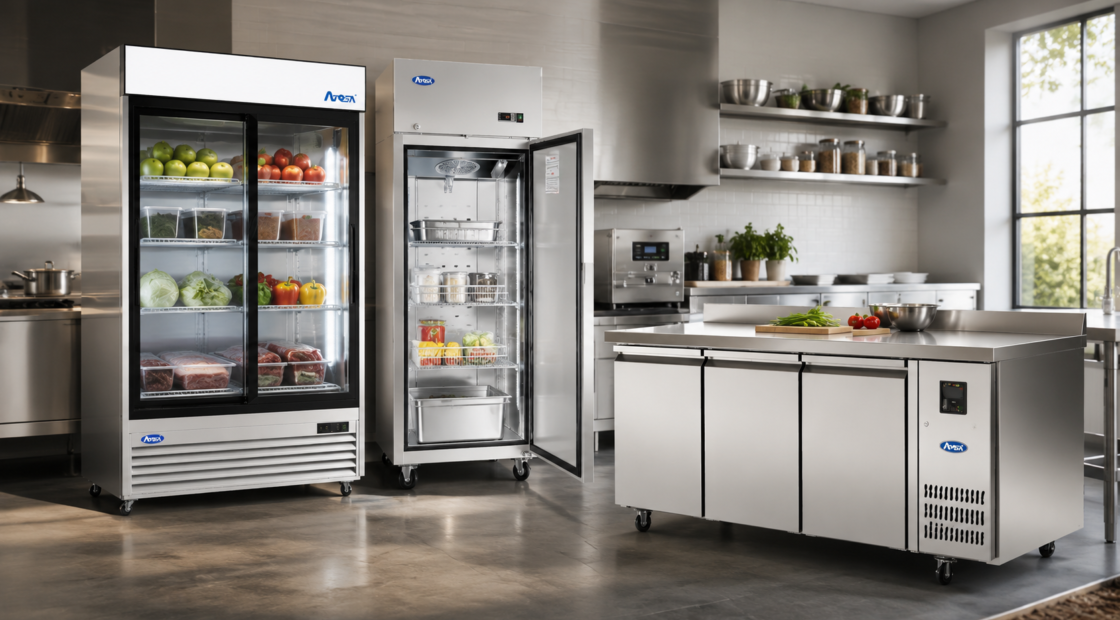
When restaurant owners, café operators, convenience stores, bars, ghost kitchens, delis, and foodservice buyers search for commercial refrigeration equipment, Atosa is one of the names they often come across. The brand appears across many high-demand categories, including reach-in refrigerators, reach-in freezers, prep tables, undercounter refrigerators, worktop refrigerators, glass door merchandisers, back bar equipment, ice machines, walk-in coolers, and more.
But the real question is not simply, “Does Atosa make commercial refrigerators?” The better question is: Is Atosa the right refrigeration brand for your operation, your budget, your kitchen layout, and your daily workload?
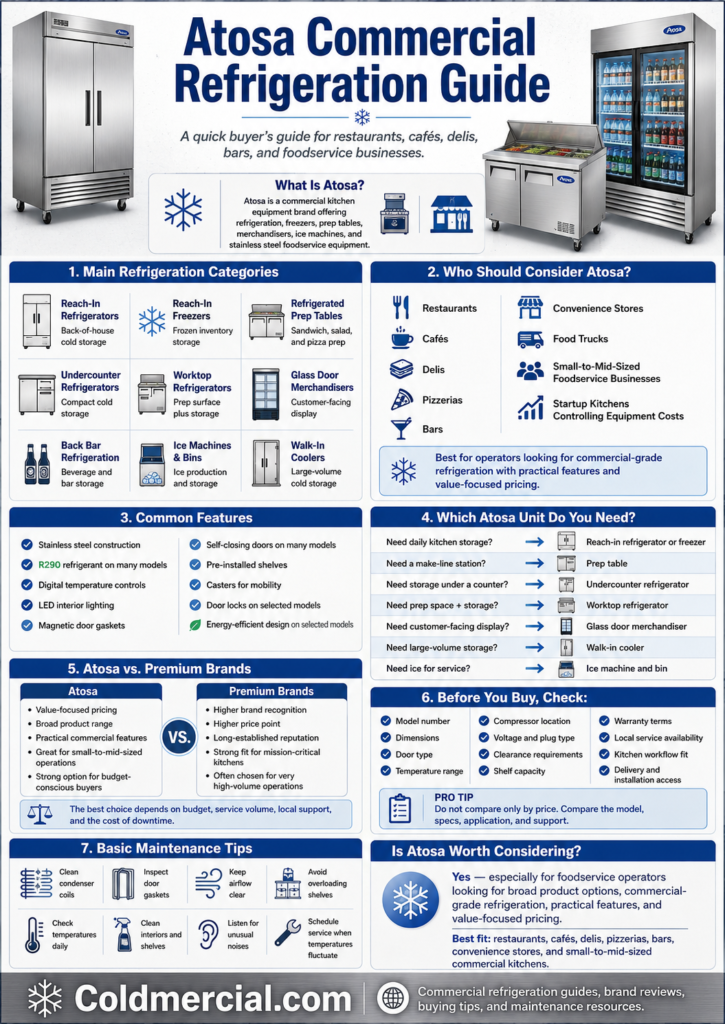
Atosa positions itself as a broad commercial kitchen equipment manufacturer serving the foodservice industry with refrigeration, freezers, cooking equipment, food preparation equipment, stainless steel fabrication, and other commercial kitchen categories. On its official product page, Atosa lists refrigeration categories such as back bar equipment, blast chillers, chef bases, chest freezers, refrigerated display cases, glass door merchandisers, ice makers and bins, milk coolers, open air merchandisers, reach-ins, refrigerated prep tables, undercounters and worktops, and walk-ins.
For buyers, that product depth matters. A restaurant may start by looking for one Atosa refrigerator, then later need a sandwich prep table, freezer, ice machine, or merchandiser. Because Atosa covers multiple equipment categories, it can be a practical brand for operators who want to standardize across several pieces of kitchen equipment instead of buying from a different manufacturer for every need.
What Is Atosa?
Atosa is a commercial kitchen equipment brand with a strong presence in commercial refrigeration and foodservice equipment. The company’s U.S. website describes its product offering around commercial refrigeration and freezers, commercial cooking equipment, work tables, equipment stands, and commercial food preparation equipment.
In the U.S. market, Atosa is especially visible in refrigeration categories. Its catalog includes reach-in refrigerators and freezers, refrigerated prep tables, undercounter refrigerators, worktop units, merchandisers, back bar equipment, ice makers, chest freezers, and walk-in coolers. According to Atosa’s official product listing, the brand has dozens of SKUs across key refrigeration groups, including reach-ins, refrigerated prep tables, glass door merchandisers, ice makers and bins, undercounters and worktops, and walk-ins.
That makes Atosa a brand worth knowing for any business that needs cold storage equipment but does not necessarily want to pay the highest price tier in the commercial refrigeration market.
Is Atosa a Good Brand for Commercial Refrigeration?
Atosa is often considered a value-focused commercial refrigeration brand. In practical terms, that means the brand is usually most attractive to buyers who want a balance between cost, stainless steel construction, modern features, warranty support, and broad product availability.
For many foodservice businesses, the refrigeration decision is not only about buying “the best” brand on paper. It is about choosing equipment that fits the actual business model. A small restaurant, pizzeria, deli, bakery, food truck commissary, café, or convenience store may not have the same budget as a high-volume hotel kitchen or national chain. Atosa fits into the market as a brand many operators consider when they want commercial-grade refrigeration without moving into the highest-priced premium segment.
That does not mean every Atosa unit is automatically the right choice for every kitchen. A buyer still needs to compare capacity, compressor placement, door type, temperature range, warranty terms, voltage, clearance requirements, interior layout, and local service availability. But as a product family, Atosa gives foodservice buyers a wide selection of commercial refrigeration options across the most common kitchen needs.
Atosa Commercial Refrigeration Product Categories
One of Atosa’s biggest advantages is category coverage. The brand is not limited to one type of refrigerator. Its official product catalog includes multiple refrigeration categories that serve different business types and kitchen layouts.
The most important Atosa refrigeration categories include:
Reach-in refrigerators and freezers for back-of-house cold storage.
Refrigerated prep tables for sandwich shops, pizzerias, salad stations, delis, and quick-service restaurants.
Undercounter and worktop refrigerators for compact kitchens where cold storage must fit under counters or below prep surfaces.
Glass door merchandisers for customer-facing beverage, grab-and-go, and packaged food display.
Back bar refrigeration for bars, restaurants, and hospitality businesses.
Ice makers and bins for restaurants, cafés, bars, hotels, convenience stores, and institutional kitchens.
Walk-in coolers for larger cold storage applications.
Chest freezers and display cases for frozen storage and retail food presentation.
This broad range makes Atosa relevant to a wide variety of organic search topics. A strong Atosa article should not only answer “Is Atosa good?” It should also help buyers understand which Atosa category fits their business.
Atosa Reach-In Refrigerators and Freezers
Reach-in refrigerators and freezers are among the most important refrigeration units in any commercial kitchen. They are used for daily ingredient storage, line support, backup inventory, dairy, produce, meat, seafood, sauces, prepared foods, frozen goods, and more.
Atosa’s reach-in category includes one-door, two-door, and three-door models, with top-mount and bottom-mount configurations appearing across the product family. On Atosa’s official reach-in category page, listed models include top mount one-door, two-door, and three-door reach-in refrigerators and freezers.
The choice between a one-door, two-door, and three-door reach-in depends on volume and kitchen workflow. A one-door reach-in may be enough for a small café, prep kitchen, or low-volume operation. A two-door refrigerator is often a better fit for restaurants with broader menus and more daily prep. Three-door reach-ins are usually better for high-volume kitchens that need significant cold storage without stepping up to a walk-in cooler.
Compressor location also matters. Top-mount compressors are often preferred in dry storage environments because they keep the compressor away from floor dust, grease, and debris. Bottom-mount compressors can be easier to access for service and may perform well in hot kitchens because they are not pulling in warmer ceiling-level air, although the best choice depends on the specific kitchen environment.
Some Atosa reach-in models use environmentally friendly R290 refrigerant, stainless steel exterior and interior construction, electronic temperature controllers, LED lighting, magnetic door gaskets, pre-installed shelves, casters, and door locks. For example, the Atosa MBF8508GR bottom-mount three-door reach-in refrigerator lists features such as R290 refrigerant, stainless steel exterior and interior, electronic temperature controller, LED interior lights, magnetic door gaskets, pre-installed casters, and three shelves per section.
Atosa Reach-In Temperature Ranges
Temperature range is one of the most important things to verify before buying any commercial refrigerator or freezer. Atosa’s listed ranges vary by product type and model.
For example, Atosa’s MBF8508GR bottom-mount reach-in refrigerator is listed as maintaining temperatures between 35°F and 38°F. Atosa’s MBF8503GR bottom-mount reach-in freezer is listed as maintaining temperatures between -8°F and 0°F.
Those ranges are relevant because restaurants need refrigeration that can hold product safely and consistently during real operating conditions. A refrigerator that is too warm can put food safety and product quality at risk. A freezer that cannot hold proper frozen temperatures can lead to thawing, frost problems, product damage, and waste.
For buyers, the key takeaway is simple: do not only compare cabinet size and price. Always check the manufacturer’s temperature range, application, and specification sheet for the exact Atosa model you are considering.
Atosa Refrigerated Prep Tables
Refrigerated prep tables are essential for restaurants that assemble food quickly during service. Pizzerias, sandwich shops, delis, salad concepts, cafés, and quick-service restaurants often rely on prep tables to keep ingredients cold while making food efficiently.
Atosa’s refrigerated prep table category includes pizza prep tables, standard top sandwich prep tables, mega top sandwich prep tables, and accessories. The official Atosa refrigerated prep table category shows pizza prep table models such as 44-inch, 67-inch, and 93-inch units, along with accessories like drawer kits and overshelves.
A prep table is different from a basic refrigerator because it supports both storage and workflow. The top rail holds pans of ingredients, while the lower refrigerated cabinet stores backup product. For a sandwich shop, that means meats, cheeses, toppings, sauces, and vegetables are within reach. For a pizzeria, it means toppings and dough-related prep can be organized around the make line.
Atosa’s mega top sandwich prep table product pages highlight features such as stainless steel construction, rear-mount compressors, R290 refrigerant, digital or electronic temperature controls, airflow designed around pans, and temperatures commonly listed around 32°F to 38°F depending on the model.
For buyers, the main prep table decisions are width, number of pans, standard top versus mega top, cabinet capacity, cutting board depth, airflow design, and whether drawers or doors are better for the operation.
Atosa Undercounter and Worktop Refrigeration
Undercounter and worktop refrigerators are designed for kitchens where space is limited. They are especially useful in bars, cafés, food trucks, concession operations, small restaurants, and prep areas where staff need refrigerated storage close to the work zone.
Atosa’s official product catalog lists undercounters and worktops as one of its major refrigeration categories, with 42 products shown in that category at the time of review.
The difference between an undercounter refrigerator and a worktop refrigerator is primarily function. An undercounter refrigerator is usually designed to fit below an existing counter or work area. A worktop refrigerator includes a durable top surface that can support light prep work. For small kitchens, this dual-purpose design can be valuable because it combines refrigerated storage and usable workspace in the same footprint.
Atosa undercounter refrigeration models often include features such as R290 refrigerant, electronic temperature control, stainless steel construction, and ENERGY STAR references on some product pages. For example, Atosa’s MGF8402GR undercounter refrigerator page lists environmentally friendly R290 refrigerant and an electronic temperature controller.
Atosa Glass Door Merchandisers
Glass door merchandisers are different from back-of-house refrigerators. Their job is not only to keep products cold but also to sell products visually. They are commonly used for bottled drinks, grab-and-go meals, desserts, packaged salads, dairy products, and impulse-buy items.
Atosa’s glass door merchandiser category is one of the larger refrigeration categories in its catalog, with 33 products shown on the Atosa product listing.
A glass door merchandiser should be evaluated based on temperature range, door style, lighting, shelf adjustability, visibility, compressor type, and how well it fits the customer-facing environment. A poorly lit merchandiser can make products look dull. A well-lit merchandiser can turn cold storage into a sales tool.
Atosa’s MCF8709GR two-glass-door merchandiser cooler lists stainless steel exterior and interior, LED interior lights, a heavy-duty Embraco compressor with R290 refrigerant, electronic temperature controller, self-closing doors with stay-open feature, magnetic door gasket, double-pane glass doors, pre-installed casters, and a NEMA 5-15P plug. It is listed as maintaining temperatures between 35°F and 38°F.
That kind of feature set is important for operators who want a merchandiser that is practical for both product display and daily use.
Atosa Ice Makers and Bins
Ice machines are easy to underestimate until they fail. Restaurants, bars, cafés, hotels, convenience stores, healthcare foodservice operations, and catering businesses rely on a steady supply of ice. Atosa’s official product catalog lists ice makers and bins as a major refrigeration-related category, with 20 products shown on the product page.
When choosing an Atosa ice machine, buyers should look at daily ice production, bin capacity, cube style, condenser type, water quality requirements, drain requirements, filter needs, and installation location. A bar may need more ice during evening service. A café may need steady ice for cold drinks throughout the day. A restaurant may need ice for both beverages and food prep.
For SEO purposes, this section is important because many buyers search by application, not just brand. They may search “Atosa ice machine,” “Atosa ice maker,” “Atosa ice bin,” or “commercial ice machine for restaurant.” A strong Atosa guide should connect the brand to those real buying questions.
Atosa Walk-In Coolers
Atosa also lists walk-ins as part of its refrigeration product catalog. The official product page shows a walk-ins category with 16 products.
Walk-in coolers are a different buying decision from reach-ins or undercounters. A reach-in supports daily access near the line. A walk-in supports bulk storage, larger inventory, and higher-volume operations. Restaurants, supermarkets, bakeries, catering kitchens, flower shops, convenience stores, warehouses, and food production spaces may all use walk-in refrigeration depending on volume and layout.
When evaluating an Atosa walk-in cooler, a buyer should consider box size, indoor versus outdoor placement, insulation, panel construction, door swing, refrigeration package, electrical requirements, floor requirements, delivery access, installation needs, and local code requirements.
Because walk-ins are more project-based than plug-in refrigeration, buyers should not treat them like a standard online refrigerator purchase. They should verify dimensions, site conditions, refrigeration specifications, and installation responsibilities before ordering.
Key Features Commonly Found in Atosa Refrigeration Equipment
While exact features vary by model, Atosa refrigeration products commonly emphasize commercial kitchen practicality. Across different product pages, recurring features include stainless steel construction, R290 refrigerant, electronic temperature controls, LED lighting, magnetic door gaskets, self-closing doors, pre-installed shelves, casters, and standard plug configurations on many models.
These features matter for real commercial use.
Stainless steel construction helps with durability, cleaning, and professional kitchen appearance.
R290 refrigerant is used in many modern commercial refrigeration systems as an alternative to older hydrofluorocarbon refrigerants. Atosa describes R290 as highly refined propane used as an environmentally friendly alternative to refrigerants such as R134a in refrigerator applications and R404a in freezer applications.
Electronic temperature controllers help operators monitor and adjust cabinet conditions more precisely than older mechanical controls.
Magnetic door gaskets help support a positive door seal, which is critical for temperature stability and energy efficiency.
Self-closing doors with stay-open features can improve workflow by closing automatically during normal use while staying open when employees need to load or unload product.
Pre-installed casters make equipment easier to move for installation, cleaning, or service access.
For buyers, these features should be compared model by model. Do not assume every Atosa unit has the exact same features. Always check the spec sheet for the model number.
Atosa Warranty and Service Support
Warranty is a major part of the buying decision for commercial refrigeration. Atosa’s warranty resources page lists downloadable warranty policies for Atosa refrigeration and ice machines, chest freezers and countertop refrigeration, CookRite cooking and holding equipment, MixRite stainless steel fabrication equipment, and PrepPal mixers, slicers, and meat grinders.
Atosa also promotes its in-house service department, Smart Kitchen Service. According to the official warranty service page, Smart Kitchen Service has over 500 technicians across the United States, assigns customers to dedicated customer service representatives, and provides warranty or technical support through its service team.
Several Atosa refrigeration product pages also reference a 2-year parts and labor warranty and show ENERGY STAR references on specific models. For example, Atosa’s MBF8508GR page includes a 2-year parts and labor warranty note and an ENERGY STAR section.
However, buyers should always confirm warranty terms for the exact product, because warranty coverage can vary by category, product type, registration status, installation conditions, and commercial use requirements.
Who Should Buy Atosa Refrigeration?
Atosa can be a strong option for several types of buyers.
A small restaurant may choose Atosa because it needs commercial refrigeration but cannot justify the cost of a top-tier premium brand for every piece of equipment. A pizzeria may consider Atosa for refrigerated pizza prep tables. A deli or sandwich shop may look at Atosa mega top prep tables. A café may consider undercounter refrigeration and glass door merchandisers. A convenience store may look at beverage merchandisers or ice machines. A growing restaurant may use Atosa reach-ins before upgrading to larger storage systems.
Atosa is especially worth considering when the buyer wants:
A commercial-grade unit at a value-focused price point
A broad selection of refrigeration categories
Stainless steel construction on many models
Common foodservice features such as casters, shelves, magnetic gaskets, and electronic controls
R290 refrigerant on many refrigeration units
Warranty and service infrastructure in the U.S.
Equipment for restaurants, cafés, bars, delis, pizzerias, and convenience stores
Atosa may not be the first choice for every buyer who wants the most premium brand name in the industry. But for operators who need functional, commercial refrigeration with strong category coverage, it belongs on the shortlist.
Atosa vs. Premium Commercial Refrigeration Brands
Buyers often compare Atosa to premium refrigeration brands such as True, Traulsen, Turbo Air, Beverage-Air, Hoshizaki, and others. The comparison usually comes down to price, reputation, service network, durability expectations, energy performance, parts availability, and how demanding the operation is.
Premium brands often have long-established reputations, deep dealer networks, and strong recognition among chefs, consultants, and facility managers. Atosa competes more strongly as a value-oriented commercial equipment brand with broad product coverage.
For a low-to-medium volume restaurant, café, bar, or deli, Atosa may offer an attractive balance between cost and capability. For extremely high-volume institutional kitchens, national chains, hospitals, hotels, or operations where equipment runs under unusually intense conditions, buyers may want to compare Atosa against premium alternatives more carefully.
The best choice depends on the cost of downtime. If a refrigerator failure would immediately shut down a major operation, premium service access and brand history may carry more weight. If the operation needs solid commercial refrigeration while controlling startup or expansion costs, Atosa may make more financial sense.
How to Choose the Right Atosa Unit
Choosing the right Atosa refrigerator, freezer, prep table, or merchandiser starts with the application.
For a back-of-house kitchen, ask whether you need a refrigerator, freezer, or both. Then decide whether one, two, or three doors are necessary. Measure the available space carefully, including height, width, depth, door swing, and ventilation clearance.
For a prep station, think about menu flow. A sandwich shop may need a mega top prep table with more pan capacity. A pizzeria may need a wider pizza prep table with enough top space for dough, toppings, and boxes. A salad concept may need more ingredient pans and easy access during service.
For a merchandiser, think like a retailer. Visibility, lighting, shelf layout, and customer access matter. A glass door refrigerator is not just a cold box; it is part of your sales floor.
For an undercounter unit, think about workspace. The equipment should support the station, not create congestion. Door access, drawer options, height, and workflow are critical.
For an ice machine, calculate peak demand, not average demand. Many businesses run out of ice during the busiest hours because they bought for a normal day instead of a rush period.
For a walk-in, treat it as a project. Verify the site, layout, refrigeration package, electrical requirements, delivery route, installation responsibility, and future capacity needs.
Atosa Maintenance Tips
Like any commercial refrigeration equipment, Atosa units need regular maintenance to perform well. Even a good refrigerator can struggle if the condenser coil is dirty, the door gasket is damaged, airflow is blocked, or employees leave doors open during service.
A basic Atosa refrigeration maintenance routine should include:
Cleaning condenser coils regularly
Checking door gaskets for tears or weak seals
Keeping air vents clear
Avoiding overloading shelves
Verifying cabinet temperature daily
Cleaning interior surfaces and shelves
Checking drain lines where applicable
Listening for unusual compressor or fan noise
Keeping equipment level
Scheduling professional service when temperatures become unstable
For prep tables, pans should be properly seated, covers should be used when appropriate, and ingredients should not be piled above recommended levels. For merchandisers, glass should be cleaned regularly, shelves should not block airflow, and door seals should be inspected often.
Maintenance is not just about protecting the machine. It protects food inventory, energy efficiency, health inspection readiness, and customer experience.