Commercial refrigeration is one of the most critical infrastructure investments in any foodservice, retail, or hospitality business. Unlike many other pieces of equipment, refrigeration systems operate 24/7, directly impact food safety, and quietly determine operational efficiency, energy costs, and compliance risk.
A poor refrigeration decision does not fail immediately. Instead, it shows up months later through rising energy bills, inconsistent temperatures, spoiled inventory, failed health inspections, or unexpected downtime during peak hours.
This guide is designed to eliminate those risks. Rather than listing products or focusing on surface-level comparisons, this buying guide walks through every decision point that actually matters when purchasing commercial refrigeration, from system type and capacity planning to long-term cost analysis and supplier selection.
Understanding Commercial Refrigeration
Commercial refrigeration is fundamentally different from residential refrigeration in both design intent and real-world performance. These systems are built to operate continuously, handle frequent door openings, recover temperature quickly, and remain compliant with strict food safety regulations.
The most common categories include walk-in coolers and freezers, reach-in refrigerators, display refrigeration, undercounter units, prep tables, and specialized refrigeration for flowers, beverages, or meat storage. Each serves a different operational purpose.
Walk-in coolers are typically used for bulk storage and inventory management in restaurants, supermarkets, commissary kitchens, and catering operations. Reach-in refrigerators prioritize speed and accessibility, making them ideal for line stations and prep areas. Display cases are engineered not only for temperature control but also for product visibility, merchandising, and customer interaction.
Beyond form factor, regulatory compliance is non-negotiable. In the U.S. market, NSF certification confirms sanitation suitability, while ETL and UL listings verify electrical and operational safety. These certifications are not marketing badges; they are often required by local health departments and insurance providers.
One of the most common and costly mistakes buyers make is attempting to use consumer-grade or lightly modified residential units in commercial environments. These units are not designed for high-cycle usage, commercial airflow demands, or prolonged compressor operation. Failure is not a matter of if, but when.
Capacity, Size, and Layout Planning
Capacity planning is where most commercial refrigerator mistakes originate.
Buying too small leads to overcrowded shelving, restricted airflow, and temperature inconsistency. Buying too large results in wasted space, unnecessary energy consumption, and inflated upfront costs. The correct choice lies in understanding how inventory moves through your operation, not just how much you store.
Effective capacity planning considers daily usage, delivery frequency, peak service periods, and future growth. A restaurant with daily deliveries has different refrigeration needs than a business storing inventory for a full week. Seasonal volume spikes must also be factored into the decision.
Physical layout matters just as much as internal capacity. Door swing direction, aisle clearance, staff movement patterns, and proximity to prep areas all influence operational efficiency. In high-volume kitchens, poorly placed refrigeration can slow service, increase labor fatigue, and create bottlenecks during peak hours.
Smaller kitchens and food trucks require especially thoughtful planning. Undercounter refrigeration and modular prep units often deliver better performance in tight spaces than oversized standalone units.
The goal is not maximum storage—it is maximum usability without compromise.
Temperature Control, Energy Efficiency, and Refrigeration Systems Explained
Temperature stability is the core function of any commercial refrigeration system, yet it is often misunderstood.
Maintaining a consistent temperature range—typically between 33°F and 40°F for refrigerated storage—is not just about food quality; it is about compliance, liability, and safety. Frequent temperature fluctuations accelerate spoilage and increase inspection risk.
Modern commercial systems rely on advanced airflow design, digital controllers, and fan-assisted cooling to ensure uniform temperature distribution. Units with poor airflow may technically reach target temperature but fail to maintain it consistently across shelves.
Compressor configuration also plays a critical role. Top-mounted compressors tend to perform better in greasy or dusty environments, while bottom-mounted systems offer easier service access and improved ergonomics. Refrigerant choice has become increasingly important as well. Environmentally friendly options like R290 not only reduce environmental impact but often deliver improved energy efficiency.
Energy efficiency should never be evaluated solely on sticker price. An Energy Star–rated unit may cost more initially but can significantly reduce operating costs over its lifespan. In most commercial settings, refrigeration energy usage compounds year after year—making efficiency a long-term financial decision, not a short-term one.
Build Quality, Materials, and Durability: What Truly Defines Commercial-Grade
Not all stainless steel is created equal, and not all equipment marketed as “commercial” truly deserves the label.
True commercial-grade refrigeration prioritizes durability under constant stress. Heavy-gauge stainless steel interiors resist corrosion and simplify sanitation. High-quality insulation minimizes temperature loss and reduces compressor workload. Door gaskets, hinges, and handles must withstand thousands of daily cycles without warping or failure.
Glass doors, where applicable, should be engineered for both insulation and visibility. Inferior glass increases condensation, energy loss, and long-term maintenance costs.
Durability is not about aesthetics—it is about how the unit performs after years of uninterrupted use. Systems designed for residential or light-duty environments simply cannot tolerate the operational demands of a commercial kitchen.
A well-built unit protects inventory, stabilizes operations, and quietly reduces long-term maintenance expenses.
Installation, Ventilation, and Maintenance: Critical Factors Before You Buy
Even the highest-quality refrigeration system will underperform—or fail entirely—if improperly installed.
Electrical requirements, ventilation clearance, ambient temperature tolerance, and floor load capacity must all be confirmed before purchase. Many issues attributed to “defective equipment” are actually the result of installation errors or unsuitable environments.
Ventilation is especially critical. Inadequate airflow around the condenser leads to overheating, increased energy consumption, and premature component failure. Indoor and outdoor installations require different considerations, and not all units are suitable for both.
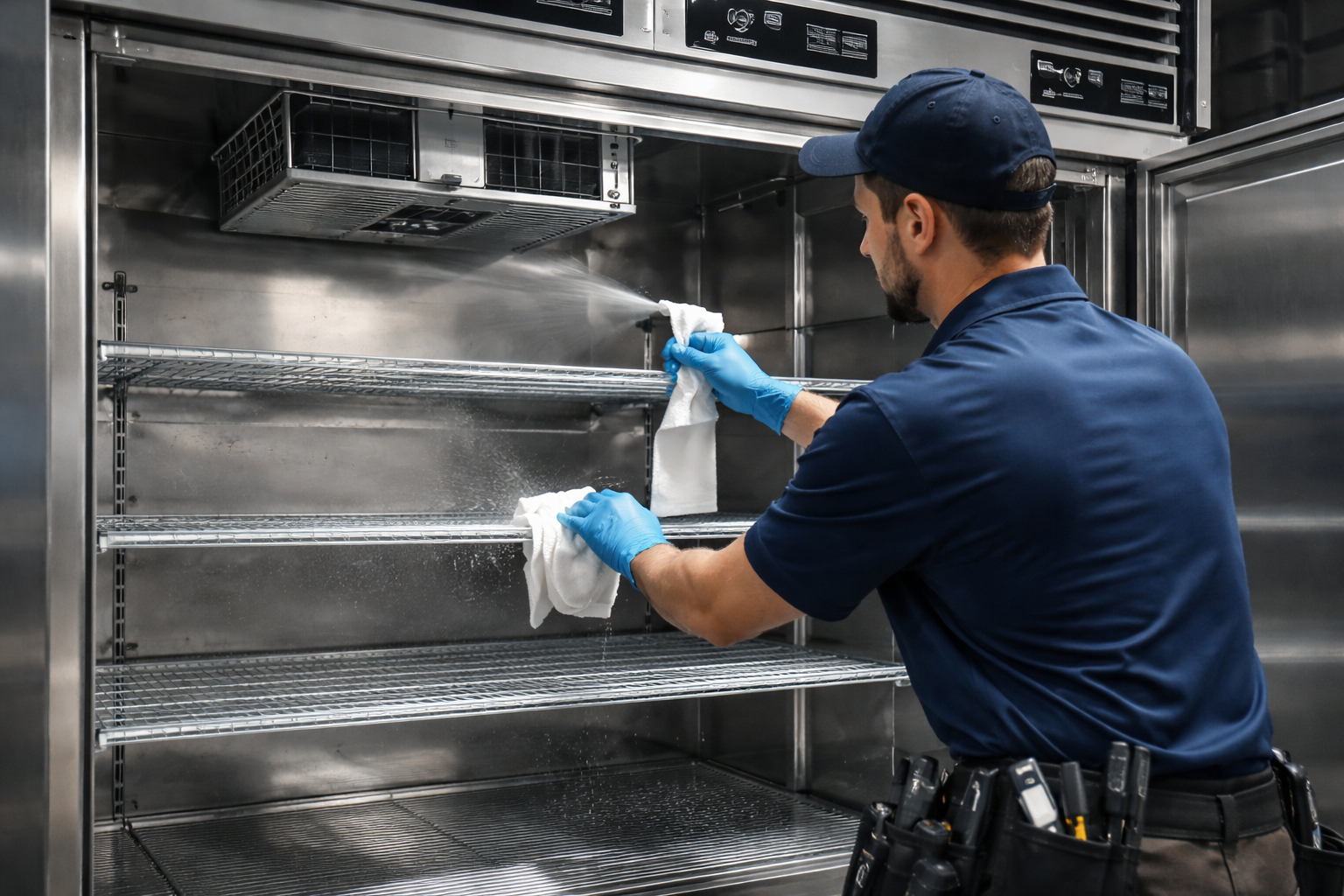
Maintenance is equally important. Daily cleaning, weekly inspections, and periodic professional servicing dramatically extend equipment lifespan. Systems designed with easy-access panels, removable filters, and straightforward serviceability reduce downtime and labor costs.
Choosing a supplier with a reliable service network can be the difference between a minor repair and a business-stopping failure.
Cost Breakdown, ROI, and Choosing the Right Supplier
Commercial refrigeration should be evaluated as a total cost of ownership investment, not a one-time purchase.
Initial price is only one component. Energy consumption, maintenance frequency, repair costs, downtime risk, and lifespan all factor into the real cost of a unit. The cheapest option upfront is often the most expensive over five to ten years.
Return on investment is achieved through reliability, efficiency, and operational stability. A unit that protects inventory, minimizes service interruptions, and controls energy costs pays for itself over time.
Supplier selection is just as important as product selection. Specialized commercial equipment suppliers provide guidance, compliance support, and post-sale service that online marketplaces cannot match. The right supplier functions as a long-term partner—not just a vendor.
Commercial refrigeration is not a background purchase. It is a system that directly affects safety, profitability, and business continuity.
The right choice protects inventory, supports staff efficiency, and reduces operational risk. The wrong choice quietly drains resources until failure becomes unavoidable.
By understanding system types, planning capacity correctly, prioritizing temperature stability, evaluating build quality, accounting for installation realities, and choosing the right supplier, businesses can make refrigeration investments that perform reliably for years.
This is not about buying equipment.
It is about building infrastructure that supports growth.