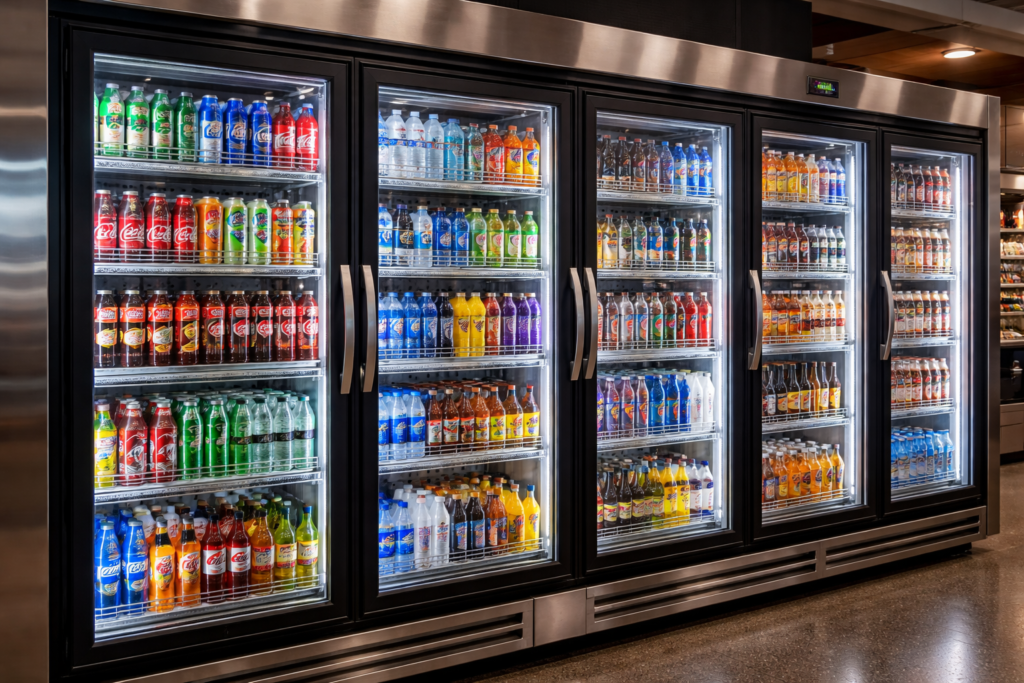
A commercial beverage cooler is not just a refrigerator that happens to hold drinks. In professional foodservice, retail, and hospitality environments, beverage coolers are revenue-generating display units, operational tools, and long-term infrastructure investments. Choosing the wrong model can lead to inconsistent temperatures, poor product visibility, higher energy bills, and lost sales. Choosing the right one, on the other hand, directly impacts impulse purchases, customer experience, and daily operational efficiency.
This guide is written to cut through marketing noise and explain commercial beverage coolers the way technicians, operators, and experienced buyers actually evaluate them.
What Counts as a Commercial Beverage Cooler
A commercial beverage cooler is a refrigeration unit engineered specifically for high-frequency access, rapid recovery after door openings, and consistent temperature control for bottled and canned drinks. Unlike residential refrigerators, commercial units are designed to operate continuously in hot, high-traffic environments such as convenience stores, restaurants, bars, cafés, gyms, and grab-and-go retail spaces.
Commercial beverage coolers generally fall into four primary categories. Glass-door merchandiser coolers are the most recognizable and are typically used in convenience stores and retail settings where visibility directly drives sales. Back-bar beverage coolers are lower-profile units designed to fit behind bars, often with sliding doors to save space. Undercounter beverage coolers are built for tight layouts and prep areas where footprint matters more than display height. Countertop beverage coolers are compact display units used for point-of-sale impulse buying.
You need a true commercial beverage cooler if your operation involves frequent door openings, front-of-house display, customer self-service, or continuous daily operation. Using a residential unit in these environments almost always results in temperature instability, premature compressor failure, and non-compliance with commercial standards.
Temperature Targets by Beverage Type
One of the most common mistakes buyers make is assuming all beverages require the same storage temperature. In reality, beverage type, packaging, and service model all influence ideal temperature targets.
Most commercial beverage coolers operate within a 34°F to 38°F (1°C to 3°C) range. This range is ideal for soft drinks, bottled water, energy drinks, and ready-to-drink beverages. Beer service often overlaps this range, though some specialty beers may be stored slightly warmer depending on brand and service preferences.
The key difference between a commercial beverage cooler and a standard glass door refrigerator is temperature stability, not just the set point. Commercial units are designed with forced-air circulation, high-output evaporator fans, and digital thermostats that quickly recover temperature after repeated door openings. In a busy convenience store or bar, doors may be opened hundreds of times per day. A unit that cannot recover quickly will gradually drift out of range, even if the thermostat reads correctly.
When evaluating a beverage cooler, professionals look for digital temperature controls, even airflow distribution, and reliable recovery performance rather than chasing ultra-low temperature specs that are unnecessary for beverages.
Sizing & Capacity That Actually Works in Real Life
On paper, beverage cooler capacity looks simple: total cubic feet or number of cans. In practice, usable capacity is determined by shelf configuration, door count, and operational workflow.
A common mistake is choosing a unit based solely on internal volume. A 48-inch single-door cooler may technically hold a similar number of beverages as a narrow two-door unit, but the two-door model often performs better in high-traffic environments because it reduces warm air infiltration and shortens door-open time.
Professionals also consider restocking flow. Shelves must be adjustable to accommodate different bottle heights, and interior depth must allow products to be faced forward without crowding. Overloading shelves restricts airflow, which leads to uneven cooling and compressor strain.
Door swing clearance, aisle spacing, and restocking access from behind the unit (in some layouts) all influence real-world performance. A properly sized beverage cooler is one that supports peak-hour demand without forcing staff to constantly rearrange products or fight temperature fluctuations.
Merchandising Features That Actually Move Product
A commercial beverage cooler is as much a sales tool as it is a refrigeration system. The most successful operators think in terms of merchandising, not just storage.
Glass quality plays a major role. Double-pane or low-emissivity glass reduces condensation and improves energy efficiency while maintaining product visibility. Anti-fog coatings and heated glass options are particularly valuable in humid environments or high-traffic locations.
Interior LED lighting is another critical feature. Properly positioned vertical or canopy lighting highlights labels without creating glare. Bright, even lighting increases perceived product freshness and encourages impulse purchases, especially in convenience retail.
Shelf adjustability matters more than most buyers realize. Wire shelves with adjustable clips allow operators to reconfigure layouts for seasonal beverages, promotions, or new product sizes. Some professional units also support price tag rails or shelf signage, which further enhances merchandising flexibility.
From a revenue standpoint, a beverage cooler that looks full, bright, and organized consistently outsells a poorly lit or cluttered unit—even when the product selection is identical.
Efficiency, Compliance, and Certifications Buyers Ignore
Energy efficiency and compliance are often treated as afterthoughts, but experienced buyers know they directly impact long-term operating costs and regulatory acceptance.
ENERGY STAR–rated commercial beverage coolers meet strict efficiency standards set by regulatory bodies. These units consume less electricity without sacrificing performance, which is especially important for equipment that runs 24/7. Over the lifespan of a cooler, energy savings can exceed the initial price difference between efficient and inefficient models.
NSF/ANSI 7 certification is another critical factor. This standard ensures that the unit is designed for safe storage of packaged food and beverages in commercial refrigerators. Health inspectors often look for NSF certification during inspections, and lack of compliance can create issues for restaurants and retail operations.
Professionals also evaluate serviceability. Easily accessible condenser coils, standard component parts, and clear service documentation reduce downtime and repair costs. A beverage cooler that is efficient but difficult to service can quickly become a liability.
Best Commercial Beverage Coolers
Rather than relying on generic “top 10” lists, industry professionals evaluate beverage coolers based on use-case performance categories.
The best overall commercial beverage cooler balances temperature stability, build quality, energy efficiency, and serviceability. These units perform reliably across multiple environments and are suitable for most retail and hospitality applications.
For convenience stores, multi-door glass merchandisers are often preferred due to high visibility and reduced door-open time. Bars and restaurants typically prioritize back-bar beverage coolers with sliding doors and quiet operation to maintain front-of-house ambiance.
Compact or countertop beverage coolers are evaluated differently. In these cases, footprint efficiency, visual impact, and ease of placement near point-of-sale matter more than raw capacity.
Budget models can make sense for low-traffic environments, but professionals always assess compressor quality, insulation thickness, and warranty coverage before committing. Premium units, on the other hand, are judged on consistency, longevity, and total cost of ownership rather than upfront price.
The most important takeaway is that there is no single “best” beverage cooler for everyone. The best unit is the one that aligns with your operational reality, traffic patterns, merchandising goals, and long-term maintenance expectations.