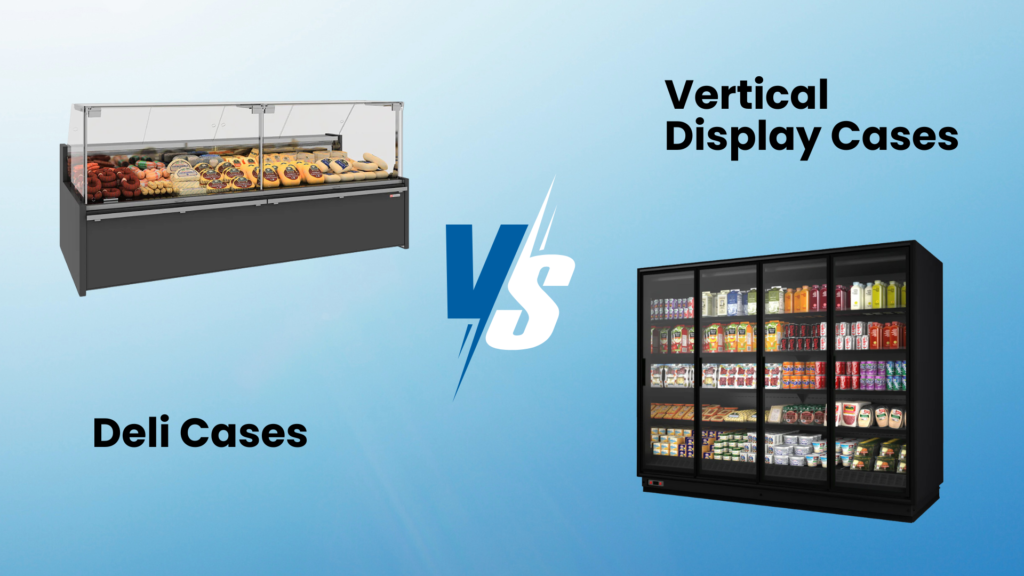
Choosing between a vertical display case and a deli case is one of the most consequential refrigeration decisions a food business can make, yet it is also one of the most misunderstood. On the surface, the distinction appears simple. One stands upright, the other sits horizontally. One looks modern and self-service oriented, the other feels traditional and staff-operated.
In reality, these two systems are built around entirely different assumptions about product behavior, customer interaction, and operational priorities. Treating them as interchangeable often leads to product waste, quality degradation, energy inefficiency, and long-term margin erosion that only becomes visible months after installation. This guide is written to remove that risk completely. It is not a quick comparison or a surface-level overview. It is a decision framework designed to help you understand why these cases behave differently, not just how they look.
Understanding the Real Purpose of a Vertical Display Case
A vertical display case exists to support speed. Speed of access, speed of decision-making, and speed of sales. These units are designed for environments where customers interact directly with refrigerated products, often without staff involvement. The engineering priorities reflect that reality.
Airflow in vertical cases is aggressive by design. Whether the unit is open-front or equipped with glass doors, it relies on forced air circulation to recover temperature quickly after frequent openings. This is essential in high-traffic environments, but it comes with trade-offs that are rarely explained at the point of sale.
Vertical display cases assume that products are sealed, packaged, or otherwise protected from direct exposure to moving air. Bottled beverages, canned drinks, packaged dairy, grab-and-go meals, and wrapped items perform well in this environment. These products can tolerate minor temperature fluctuations and low humidity without compromising quality or safety.
Where problems begin is when vertical cases are used for products they were never designed to protect. Fresh or minimally wrapped foods, particularly proteins and cheeses, respond poorly to continuous airflow. Moisture loss, surface drying, discoloration, and reduced shelf life are not defects in the equipment. They are predictable outcomes of using the wrong tool for the job.
Why Deli Cases Exist in the First Place
Deli cases were not designed to compete with vertical display cases. They were created to solve a different problem entirely: how to display fresh food without destroying it.
Unlike vertical cases, deli cases are engineered around product preservation rather than rapid turnover. Airflow is slower, more controlled, and carefully directed to avoid blowing directly across exposed surfaces. Temperature stability is tighter, and humidity retention is significantly higher. These characteristics are not accidental. They are essential for maintaining the texture, color, and weight of fresh foods.
This is why butcher shops, delicatessens, seafood counters, and specialty food retailers continue to rely on deli cases even as retail trends shift toward self-service. The deli case is not outdated. It is purpose-built for products that demand environmental stability.
When a customer looks at fresh meat or cheese behind a deli case, they are not just seeing a product. They are seeing a signal of quality control. That perception has measurable impact on trust, pricing power, and brand positioning.
Airflow: Where Most Buying Mistakes Begin
Airflow is the single most important technical difference between vertical display cases and deli cases, and it is also the most commonly ignored.
Vertical display cases move air constantly and deliberately. The goal is to create a thermal barrier between the refrigerated interior and the store environment. This design works exceptionally well for packaged goods, but it strips moisture from exposed surfaces over time. In practical terms, this means weight loss, visual degradation, and shorter shelf life for fresh products.
Deli cases take the opposite approach. Air movement is minimized and diffused. Temperature is maintained without creating a drying effect. The product environment is calmer, more stable, and more forgiving. This difference alone explains why the same product can look acceptable in one case and visibly deteriorated in another within hours.
Understanding airflow is not a technical luxury. It is the difference between protecting inventory and silently losing it.
Temperature Stability Matters More Than Temperature Accuracy
Many buyers focus on temperature setpoints and ignore temperature behavior. A unit can technically hold the correct temperature while still damaging the product inside it.
Vertical display cases experience frequent micro-fluctuations due to door openings, customer interaction, and ambient conditions. For packaged goods, this is rarely an issue. For fresh foods, it is a constant stressor.
Deli cases are designed to minimize these fluctuations. Temperature remains consistent across the product surface throughout the day. This stability is critical for food safety, regulatory compliance, and quality retention, especially for proteins and prepared foods.
The difference is subtle on a specification sheet, but dramatic in real-world operation.
Humidity: The Hidden Profit Variable
Humidity control is one of the least discussed aspects of commercial refrigeration, yet it directly affects profitability.
Vertical display cases operate in low-humidity environments by nature. This accelerates dehydration. For products sold by weight, such as meat and cheese, moisture loss translates directly into lost revenue. For products sold by appearance, it leads to reduced perceived freshness and increased waste.
Deli cases are designed to retain humidity and protect product integrity. The result is longer shelf life, better appearance, and more predictable yields. Over time, these differences compound into measurable financial impact.
Sales Velocity vs Product Integrity
Vertical display cases excel at driving impulse purchases. They reduce labor requirements, increase customer autonomy, and support fast-moving inventory. For the right products, they are incredibly effective.
Deli cases, on the other hand, support premium positioning. They slow the transaction slightly, but they elevate perceived quality and trust. In many operations, this trade-off is not a drawback but a strategic advantage.
The mistake is not choosing one over the other. The mistake is choosing based on appearance or footprint instead of product behavior.
Energy Consumption and Long-Term Cost Reality
From an energy perspective, vertical display cases—particularly open-front models—are inherently more demanding. They exchange air continuously with the surrounding environment and rely on constant compressor activity to maintain setpoints.
Deli cases, by contrast, operate in a more controlled thermal environment. Energy use per cubic foot is often lower, and performance is more predictable. Over the lifespan of the equipment, these differences can represent thousands of dollars in operating costs.
Energy efficiency should never be evaluated in isolation. It must be considered in the context of product loss, labor, and sales performance.
Compliance, Risk, and Operational Liability
Food safety regulations do not evaluate refrigeration equipment based on marketing categories. They evaluate outcomes: temperature stability, exposure risk, and contamination potential.
Using a vertical display case where a deli case is required may not trigger immediate failure, but it increases inspection risk and liability exposure. Deli cases provide a higher margin of safety for sensitive products and simplify compliance in regulated environments.
The Right Question to Ask Before Buying
The correct question is not “Which case is better?”
The correct question is “What does my product need to survive and sell well?”
If your products are sealed, high-turnover, and impulse-driven, a vertical display case is often the right answer. If your products are fresh, exposed, or quality-sensitive, a deli case is not optional—it is essential.