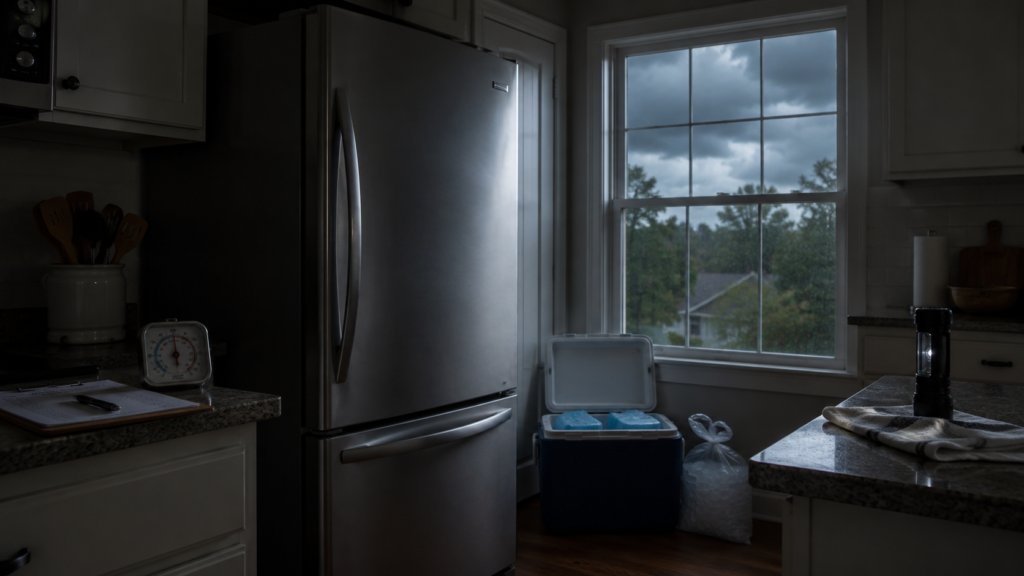
A refrigerator can usually stay cold for about 4 hours without power if the door is kept closed. After that, perishable foods such as meat, poultry, seafood, milk, eggs, soft cheeses, cut fruit, and leftovers may become unsafe, especially if the temperature rises above 40°F.
That is the simple answer. But in real life, power outages are rarely simple.
Maybe the power went out during a storm while you were asleep. Maybe your restaurant lost electricity during lunch service. Maybe your walk-in cooler stopped running overnight. Maybe the power came back before you noticed, and now you are trying to decide whether the food is still safe. The question is not just “how long can a refrigerator stay cold without power?” The real question is: how do you know what is safe, what is risky, and what needs to be thrown away?
This guide explains how long refrigerators and freezers stay cold during an outage, why the 4-hour rule matters, which foods are most at risk, what to do during an outage, what to check after the power returns, and how commercial kitchens, restaurants, grocery stores, and food businesses should think differently from home users.
Power outages are inconvenient at home. In a food business, they can become expensive quickly. One failed cooler can mean lost inventory, food safety risk, emergency service calls, customer complaints, and possible health department issues. Understanding the science of cold storage helps you make better decisions before, during, and after an outage.
The Quick Answer: About 4 Hours If the Door Stays Closed
A standard refrigerator can keep food cold for about 4 hours without power if the door remains closed. The more often the door is opened, the faster the temperature rises.
This 4-hour window is not a magic guarantee. It is a food safety guideline based on the idea that refrigerated perishable food should not remain too long above safe cold holding temperatures. If the refrigerator door stays closed, the insulated cabinet, cold air, cold shelves, and chilled food inside all help slow down temperature rise.
But once the power is out, the refrigerator is no longer actively removing heat. Heat begins moving in from the surrounding room. Every door opening releases cold air and brings in warmer air. The unit slowly warms up, and eventually food temperature can move into a range where bacteria grow more quickly.
The most important rule during a power outage is simple:
Keep the refrigerator and freezer doors closed.
Do not keep opening the door to “check if it is still cold.” Every check makes the situation worse. If you have an appliance thermometer inside, wait and check only when needed. If you do not have one, the 4-hour rule becomes even more important because you are making decisions without actual temperature data.
How Long Can a Freezer Stay Cold Without Power?
A freezer usually stays cold much longer than a refrigerator.
A full freezer can often keep food safe for about 48 hours if the door stays closed. A half-full freezer can usually hold temperature for about 24 hours. The reason is thermal mass. Frozen food acts like blocks of ice. The more frozen material inside the freezer, the longer the temperature stays low.
A nearly empty freezer warms faster because there is less frozen mass to absorb heat. A full freezer warms more slowly because all those frozen items help hold the cold.
This is why many food safety experts recommend keeping freezers well stocked if you live in an area with frequent outages. If you do not have enough food to fill the freezer, containers of frozen water can help add thermal mass. They keep the freezer colder longer during an outage, and they can also be moved into a cooler if needed.
For frozen food, safety decisions depend on temperature and condition. If food still contains ice crystals or has stayed at 40°F or below, it may often be refrozen or cooked. If it has fully thawed and stayed above 40°F for too long, especially meat, seafood, poultry, cooked dishes, or dairy-heavy foods, it may need to be discarded.
Why 40°F Matters
The number 40°F is one of the most important numbers in food safety.
Refrigerators are generally expected to keep food at 40°F or below. Freezers should be at 0°F or below. When perishable food rises above safe refrigeration temperature, bacteria can begin multiplying more quickly. The longer food remains warm, the greater the risk.
Many people make the mistake of judging food by smell, taste, or appearance. That is dangerous. Food can look normal and still be unsafe. Harmful bacteria do not always create a bad smell. A carton of milk, a tray of chicken, or a container of cooked rice may look fine while still carrying risk if it has been time-temperature abused.
This is why temperature matters more than instinct. The safest tool is an appliance thermometer. Ideally, every refrigerator and freezer should have one. In a commercial kitchen, temperature monitoring should be part of daily operations, not something you think about only during emergencies.
Without a thermometer, you are guessing. With a thermometer, you can make a more informed decision.
What Makes One Refrigerator Stay Cold Longer Than Another?
Not every refrigerator warms at the same speed during an outage. Several factors affect how long food stays cold.
The first factor is door opening. A refrigerator that stays closed may keep food safe for about 4 hours. A refrigerator that is opened repeatedly may warm much faster. In a busy restaurant or large household, this is the biggest controllable factor.
The second factor is how full the refrigerator is. Cold food helps hold cold temperature. A refrigerator with many chilled items may warm more slowly than an almost empty one. However, refrigerators are different from freezers because airflow still matters. Overloading a refrigerator can block air circulation during normal operation, but during an outage, chilled mass can help slow warming.
The third factor is room temperature. A refrigerator in a hot kitchen, garage, food truck, or poorly air-conditioned space will warm faster than one in a cool room. During summer storms, this becomes especially important.
The fourth factor is the condition of the refrigerator. Good door gaskets, tight seals, clean coils, proper insulation, and a well-maintained cabinet help the unit perform better before the outage and slow temperature rise after power is lost. A refrigerator with damaged gaskets or a door that does not close properly loses cold air faster.
The fifth factor is the type of equipment. A small undercounter refrigerator, a large household refrigerator, a commercial reach-in, a prep table, a display case, and a walk-in cooler do not behave exactly the same way. Commercial refrigeration equipment may have larger doors, more airflow, more product volume, and heavier use patterns. That makes operational discipline even more important.
What to Do Immediately When the Power Goes Out
When the power goes out, the first step is not to panic. The first step is to protect the cold air you already have.
Keep refrigerator and freezer doors closed. Tell everyone in the home or business not to open them. If you operate a restaurant or food business, assign one person to manage the situation. Random door opening by multiple employees can quickly reduce safe holding time.
Check the time when the outage started. Write it down. If you do not know the exact time, estimate conservatively. For restaurants and commercial kitchens, documentation matters. You may need to show when the outage began, what temperatures were recorded, and what action was taken.
If you have appliance thermometers or a digital monitoring system, check temperatures without unnecessary door opening. Some commercial systems may have external displays, alarms, or remote monitoring. These are valuable because they allow you to understand what is happening without opening the cooler.
If the outage may last longer than 4 hours, start planning. Do not wait until the refrigerator is already warm. Consider moving critical perishables to a working refrigerator, freezer, insulated cooler with ice, refrigerated truck, backup cold storage, or another approved safe location. For a business, this should already be part of an emergency plan.
For home users, coolers with ice or frozen gel packs can help protect high-value perishables. For businesses, food safety rules are stricter, and local health department expectations may apply.
Should You Put Food Outside During a Winter Power Outage?
This is a common question. It feels logical. If it is cold outside, why not put the food outdoors?
In most cases, this is not the best food safety solution.
Outdoor temperatures fluctuate. Sunlight can warm food even when the air feels cold. Food can be exposed to animals, dirt, moisture, and contamination. Frozen food may thaw and refreeze without you realizing it. Refrigerated food may move above and below safe temperatures repeatedly.
A better option is to use coolers with ice, frozen gel packs, or clean snow placed around sealed containers where appropriate. The food should remain protected, covered, and measurable. You still need to monitor temperature.
For commercial food businesses, putting food outside is generally not an acceptable cold holding plan. Restaurants, delis, grocery stores, and commercial kitchens need controlled, sanitary, and documentable food storage conditions.
Cold weather can help, but it should not replace food safety control.
Which Foods Should Be Thrown Away After 4 Hours Without Power?
After more than 4 hours without power, refrigerated perishable foods are the biggest concern, especially if the refrigerator temperature has gone above 40°F.
High-risk foods include raw meat, poultry, seafood, deli meat, cooked leftovers, milk, cream, yogurt, soft cheese, eggs, cooked pasta, cooked rice, cut fruit, cut melon, prepared salads, opened packages of tofu, fresh sauces, and many ready-to-eat foods.
These foods support bacterial growth more easily because they contain moisture, nutrients, and favorable conditions. If they spend too long at unsafe temperatures, they can become dangerous even if they smell fine.
In a home, throwing food away feels wasteful. In a restaurant, it can feel financially painful. But foodborne illness is far more costly than lost inventory. A single unsafe decision can affect customers, staff, reputation, and legal exposure.
When in doubt, throw it out. That phrase may sound simple, but it exists because guessing is dangerous.
Which Foods May Still Be Safe?
Not every item in the refrigerator automatically becomes unsafe after an outage. Some foods are less risky because they are acidic, dry, high in sugar, high in salt, or otherwise less supportive of bacterial growth.
Items that may often be safer include whole fresh fruits, uncut vegetables, hard cheeses, butter or margarine, sealed fruit juices, breads, peanut butter, jams, jellies, mustard, ketchup, pickles, vinegar-based condiments, and some high-acid sauces.
However, context matters. Was the item opened? Was it contaminated by raw meat juices? Was it stored properly before the outage? Did it sit above safe temperature for a long time? Does it show signs of spoilage? Is it being served in a commercial environment where stricter rules apply?
For a restaurant, the decision is not only “would I eat this at home?” The decision is “can I safely and legally serve this to customers?” Those are very different standards.
What to Check When the Power Comes Back
When the power returns, do not assume everything is fine. The refrigerator may start running again, but the food may already have spent too long at unsafe temperatures.
First, check the appliance thermometer. If the refrigerator is at or below 40°F and the power was out for less than 4 hours with the door closed, many foods may be safe. If the temperature is above 40°F and the outage lasted more than 4 hours, perishable foods should be treated with caution and often discarded.
Second, check individual food temperatures if you have a food thermometer. In commercial kitchens, this is especially important. Measure the temperature of the food itself, not only the air inside the unit. Air temperature can drop quickly after power returns, while food may have been warm for too long.
Third, inspect for evidence of thawing, dripping, leaking, or cross-contamination. In freezers, look for ice crystals. Food that still has ice crystals or stayed at 40°F or below may often be refrozen, although quality may suffer. Food that fully thawed and stayed warm may not be safe.
Fourth, separate home logic from business logic. A homeowner may make a judgment for personal use. A restaurant must protect customers and follow food safety standards.
Refrigerator vs Walk-In Cooler During a Power Outage
A walk-in cooler is not just a bigger household refrigerator. It has different airflow, door traffic, product volume, insulation, refrigeration capacity, and operational demands.
In some cases, a well-insulated walk-in cooler with a large amount of cold product may hold temperature longer than a small refrigerator, especially if the door stays closed. In other cases, a walk-in cooler in a hot kitchen with frequent staff traffic may warm quickly. The outcome depends on the box size, insulation, door seals, product load, ambient temperature, and how often the door is opened.
For restaurants, the biggest danger is human behavior. During an outage, employees may keep opening the walk-in to grab product, inspect shelves, or move items. Every opening exchanges cold air for warm air. If the outage continues, the cooler can quickly move out of safe range.
A good emergency plan should include clear rules:
Do not open the walk-in unless necessary.
Record the outage start time.
Monitor temperature.
Move high-risk inventory first if backup cold storage is available.
Keep raw meats separated to prevent cross-contamination.
Document discarded food.
Call a refrigeration technician if the unit does not restart properly after power returns.
For businesses, power outages are not only electrical events. They are food safety events.
What About Commercial Reach-In Refrigerators and Prep Tables?
Commercial reach-in refrigerators, sandwich prep tables, pizza prep units, undercounter refrigerators, and display coolers can warm faster than owners expect. Many have doors or lids that are opened frequently during service. Prep tables may also contain smaller pans of food near the top opening, where temperature can rise quickly.
During a power outage, prep table food should be treated carefully. If the unit loses power during service, stop using it as normal storage. Keep lids closed. Move time-temperature sensitive ingredients to a safer cold holding location if possible. Monitor food temperatures with a calibrated thermometer.
Display cases are also vulnerable because many are designed for merchandising, not long-term cold retention without power. Open-air merchandisers, deli cases, and beverage displays may lose cold faster than sealed refrigerators. The more open the equipment design, the less protection you have during an outage.
This is why power outage planning is especially important for grocery stores, delis, convenience stores, cafes, and restaurants with multiple refrigeration points.
How to Prepare Before the Next Power Outage
The best time to prepare for a power outage is before the power goes out.
Start with thermometers. Every refrigerator and freezer should have an appliance thermometer. In a business, temperature logs or digital monitoring systems are even better. You cannot manage what you cannot measure.
Keep freezers full when possible. If you have empty space, freeze containers of water. This adds thermal mass and gives you extra ice during an emergency.
Know where you can move food. For a restaurant, this may mean another location, refrigerated truck, nearby commissary kitchen, backup generator, or emergency cold storage partner. Do not wait until the outage to figure this out.
Keep coolers, ice packs, and food-safe containers available. If you operate a commercial kitchen, make sure employees know which items are highest priority. Raw meat, seafood, dairy, cooked foods, and ready-to-eat items need special attention.
Maintain refrigeration equipment. Dirty condenser coils, weak door gaskets, damaged hinges, failing fans, and poor insulation can make temperature control worse even before an outage. A well-maintained refrigerator starts from a better condition and may recover more reliably when power returns.
For businesses, consider backup power. A generator or backup system may be expensive, but the cost of lost inventory and downtime can be higher. For restaurants with large walk-ins, supermarkets, florists, cold storage facilities, and food distributors, backup power is not just convenience. It can be risk management.
What Restaurants Should Do During a Power Outage
Restaurants need a more disciplined plan than a home kitchen.
The first priority is food safety. Stop opening refrigeration equipment unnecessarily. Record the time. Check temperatures. Decide whether service can continue safely. If cold holding is compromised, do not keep preparing food as if nothing happened.
The second priority is documentation. Write down the outage start time, equipment temperatures, food temperatures, actions taken, and disposal decisions. If the health department, insurance company, or management team asks what happened, documentation matters.
The third priority is inventory triage. Not all inventory has the same risk or value. High-risk perishables should be prioritized for safe transfer if backup cold storage is available. Raw proteins should be managed carefully to avoid leakage and cross-contamination. Ready-to-eat foods should be protected because they will not receive a cooking step before service.
The fourth priority is communication. Staff should know what not to touch, what to move, what to record, and who is responsible. A chaotic kitchen can turn a short power outage into a serious food safety problem.
Finally, when power returns, do not immediately resume normal service until equipment and food temperatures have been evaluated. A walk-in cooler may be running again, but the food inside may not be safe.
Can You Save Food by Cooking It After the Power Comes Back?
Sometimes people think that if refrigerated food warmed up during an outage, they can simply cook it and make it safe. This is not always reliable.
Cooking can kill many bacteria, but it may not remove all toxins produced by certain bacteria. Also, cross-contamination may already have occurred. If food has been held too long at unsafe temperatures, cooking is not a guaranteed reset button.
For home users, follow food safety guidance and avoid taking risks with high-risk foods. For restaurants, do not rely on cooking as an excuse to serve time-temperature abused food. If the food has exceeded safe limits, discard it.
The goal is not to rescue every item. The goal is to prevent illness.
What If the Power Goes Out Overnight?
Overnight outages are especially difficult because you may not know exactly when the power failed.
If you wake up and the refrigerator is running, the power may have returned before you noticed. That does not automatically mean the food stayed safe. Check the appliance thermometer if you have one. If you do not know how long the power was out and the food feels warm or the refrigerator temperature is above 40°F, be cautious with perishables.
For the freezer, look for signs of thawing and refreezing. Ice cream that melted and refroze, packages with frozen liquid at the bottom, meat juices that leaked and refroze, or misshapen frozen items can suggest the freezer warmed significantly.
A simple trick for future outages is to keep a small frozen cup of water with a coin on top in the freezer. If the power goes out long enough for the ice to melt, the coin may sink and refreeze lower in the cup. This is not a substitute for a thermometer, but it can provide a clue that thawing occurred.
For businesses, overnight protection should rely on monitoring systems, alarms, and written procedures, not tricks. A temperature monitoring system that sends alerts can prevent major inventory loss.
Why Refrigeration Recovery After Power Returns Still Matters
When electricity returns, the refrigeration system has to recover. The compressor starts running, fans move air again, and the unit begins pulling heat out of the cabinet or room. But recovery takes time.
A refrigerator full of warm food will not instantly become safe just because the air temperature begins dropping. Food temperature lags behind air temperature. Dense items like meat, dairy containers, and large pans of prepared food can take longer to cool back down.
This is especially important in commercial refrigeration. A walk-in cooler may show a dropping air temperature after power returns, but product temperatures may still be elevated. For food safety, product temperature matters.
Power restoration can also stress equipment. Compressors may short cycle, controls may reset, breakers may trip, and older equipment may fail to restart properly. If your commercial refrigerator or walk-in cooler does not return to normal temperature quickly, call a qualified refrigeration technician.
How Long Can a Refrigerator Stay Cold Without Power in a Restaurant?
The general 4-hour guideline still matters, but restaurants should think more conservatively.
In a restaurant, refrigeration equipment may be opened more often, the kitchen may be warmer, and food may be served to the public. A home refrigerator mostly protects one household. A restaurant refrigerator protects customers and the business. That raises the standard.
Commercial kitchens should use temperature logs, calibrated food thermometers, appliance thermometers, and clear food discard policies. If cold food rises above safe holding temperature for too long, it should not be served.
A restaurant should also know the difference between equipment types. A closed walk-in cooler may hold temperature differently from an open prep table. A reach-in refrigerator in a hot cookline may warm faster than a back-of-house cooler. A glass-door merchandiser may lose cold faster than a solid-door unit.
The right question for a restaurant is not only “how many hours has the power been out?” It is also “what is the food temperature, what type of food is it, how long has it been unsafe, and can we prove it was handled correctly?”
Common Mistakes During a Refrigerator Power Outage
The first mistake is opening the door repeatedly. People naturally want to check the food, but checking too often speeds warming.
The second mistake is trusting smell. Food can be unsafe without smelling bad.
The third mistake is ignoring the freezer. Many people focus on the refrigerator and forget that frozen food may still be safe if handled correctly.
The fourth mistake is waiting too long to act. If you suspect the outage will last more than 4 hours, start planning before the refrigerator warms up.
The fifth mistake is assuming commercial equipment is automatically safer. A walk-in cooler is powerful when electricity is available, but without power it is still an insulated box. Door openings, heat load, and product temperature still matter.
The sixth mistake is failing to document. In a business, undocumented food safety decisions are hard to defend.
A Simple Power Outage Food Safety Checklist
When the power goes out, use this simple sequence.
Keep refrigerator and freezer doors closed.
Write down the time the outage started.
Check appliance thermometers if available.
Do not taste food to test safety.
If the outage may exceed 4 hours, prepare coolers, ice, backup refrigeration, or food transfer.
After power returns, check refrigerator and food temperatures.
Discard refrigerated perishables if they were above safe temperature too long.
For frozen foods, check for ice crystals and temperature.
Document decisions in commercial kitchens.
Call a refrigeration professional if equipment does not recover properly.
This checklist is simple because emergency procedures should be simple. During an outage, staff and households need clear rules, not complicated theory.
How Long Can a Refrigerator Stay Cold Without Power?
A refrigerator can usually keep food cold for about 4 hours without power if the door stays closed. A full freezer can usually keep food cold for about 48 hours, and a half-full freezer for about 24 hours, as long as the door remains closed.
After 4 hours, refrigerated perishable foods become risky if they have been above 40°F. Meat, poultry, seafood, eggs, milk, soft cheeses, cooked leftovers, cut fruit, and prepared foods should be handled with caution and often discarded if safe temperature cannot be confirmed.
For home users, the best protection is simple: keep doors closed, use appliance thermometers, have coolers and ice ready, and do not take risks with perishable food.
For restaurants and food businesses, the standard is higher. Power outages require temperature monitoring, documentation, inventory decisions, employee control, and sometimes emergency refrigeration service. A few hours without power can become a serious food safety and financial issue if there is no plan.
The refrigerator does not keep food safe because the box feels cold. It keeps food safe because it maintains the right temperature for the right amount of time. When power is lost, time and temperature become the whole story.
Keep the door closed. Watch the clock. Measure the temperature. Protect the food. And when you are not sure, do not gamble with safety.