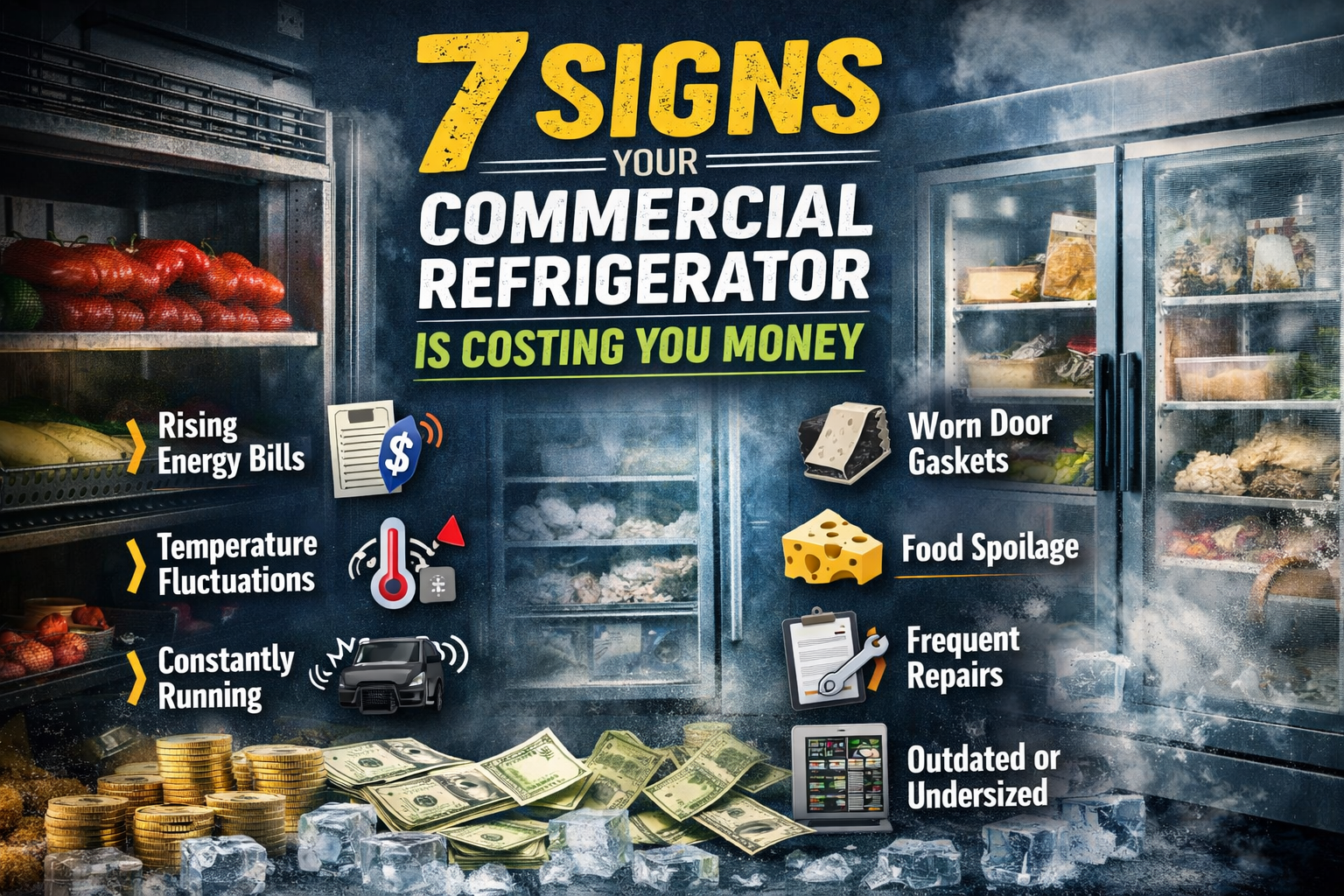
In foodservice, refrigeration problems rarely begin with a complete breakdown. They usually start quietly. A slightly longer recovery time after the door opens. A cabinet that still feels cold, but not quite as steady as it used to. A compressor that seems to run longer. A prep team that has learned to “work around” a unit instead of trusting it. By the time the refrigerator fully fails, the financial damage often started weeks or months earlier.
That is what makes commercial refrigeration so expensive when it underperforms. The cost is not limited to a repair invoice. It shows up in higher utility bills, lost product, food safety risk, labor inefficiency, emergency service calls, and shortened equipment life. For restaurant owners, deli operators, c-store managers, and other food business operators, the real question is not simply whether a refrigerator still runs. The real question is whether it is running efficiently enough to justify keeping it in service.
Energy efficiency alone is a meaningful factor. ENERGY STAR notes that certified commercial refrigerators and freezers can reduce utility costs, and depending on the category, certified units can save businesses from roughly tens to more than one hundred dollars annually per unit, with lifetime savings that compound over years of operation. In restaurants, ENERGY STAR also emphasizes that kitchen equipment efficiency directly affects the bottom line.
If your refrigerator is showing any of the signs below, it may be doing more than cooling product. It may be quietly draining profit.
1. Your Energy Bills Keep Rising Without a Clear Reason
One of the earliest signs that a commercial refrigerator is becoming expensive to own is an unexplained increase in electricity usage. Operators often notice the total utility bill climbing but do not immediately connect it to refrigeration. That is understandable. A reach-in or merchandiser can continue operating while becoming less efficient month after month. The unit still cools, so it does not feel broken. But inside the system, the compressor may be working harder and longer than it should.
This is where older or neglected equipment starts to hurt margins. Dirty condenser coils, restricted airflow, worn gaskets, and inconsistent temperature recovery all force the refrigeration system to consume more energy than a well-maintained unit. Manufacturers and service resources repeatedly point to condenser cleanliness as a major efficiency factor. True Manufacturing states that condenser coils accumulate dirt and should be cleaned every 30 days or as needed, warning that a dirty coil can lead to cabinet failure and repairs not covered by warranty. WebstaurantStore likewise notes that dirty coils make the system work harder and can lead to higher electricity usage.
For operators with multiple refrigeration units, the issue becomes even more serious. A single inefficient refrigerator may look manageable on paper. Three, five, or eight inefficient units across a kitchen, bar, prep line, or front-of-house display setup can quietly become a major overhead leak. If your electricity costs have been trending upward and nothing else in your operation has changed significantly, refrigeration deserves a hard look.
2. The Unit Struggles to Hold Safe Temperature
Temperature instability is not only a maintenance problem. It is a money problem and a liability problem. The FDA’s retail food guidance consistently reinforces cold holding at 41°F or below for temperature-controlled foods, and that threshold matters because once product spends too much time above safe limits, spoilage risk and food safety exposure increase sharply.
When a commercial refrigerator starts drifting above set temperature, taking too long to pull product back down, or showing fluctuations throughout the day, it is no longer just an appliance issue. It is putting inventory at risk. In a real operation, this can mean dairy, prepared foods, proteins, sauces, garnishes, deli items, and high-turnover ingredients all living in a more dangerous temperature band than staff realizes. If a power interruption or temperature event pushes refrigerated perishables above 40°F for four hours or more, FDA consumer guidance advises discarding them. That makes temperature failure directly connected to waste.
Even when product is not discarded, inconsistent temperature creates hidden inefficiency. Staff begin checking items more often, rotating stock defensively, shifting product to other units, or avoiding certain shelves because they do not trust the cabinet. That loss of confidence slows the kitchen down. In other words, a refrigerator that cannot hold temperature reliably is costing money long before it completely goes down.
3. The Compressor Seems to Run Constantly
A healthy refrigeration cycle should not feel calm all day long, but it also should not sound like the unit is in a permanent fight to survive. If the compressor appears to run almost nonstop, takes unusually long to recover after the door opens, or cycles more aggressively than before, that is usually a signal that the refrigerator is compensating for another issue. Restricted airflow, dirty coils, leaking door seals, high ambient conditions, poor loading practices, or aging components can all drive longer run times.
Long compressor run time matters because refrigeration energy use is tied to how hard the system has to work to reject heat and maintain internal temperature. The harder it works, the more electricity it consumes and the faster wear accumulates on critical components. This is part of why cleaning and preventive maintenance are not optional housekeeping tasks. They directly affect operating cost and compressor life. Resources from both manufacturers and service-oriented guides stress that clean condenser surfaces are essential to efficient operation.
From a business standpoint, a constantly running refrigerator should be treated as an early warning sign. It is similar to a delivery van that still drives but has the check-engine light on and poor fuel economy. Waiting until it stops is usually the most expensive way to manage it.
4. Your Door Gaskets Are Torn, Loose, or No Longer Sealing Properly
Few refrigeration issues are as overlooked as worn door gaskets. Because they are cheap compared to compressors or evaporator components, operators tend to delay replacement. But a damaged gasket can be one of the fastest ways to lose efficiency. When the seal is weak, cold air escapes and warm kitchen air enters. That extra heat load forces the refrigerator to run harder, recover more often, and maintain less stable temperatures. WebstaurantStore’s troubleshooting guidance specifically flags worn or damaged gaskets as a cause of cold air leakage and heavier system workload.
In a fast-paced restaurant or deli, that leakage compounds quickly. Doors open often. The ambient kitchen may already be warm. Humidity may be high. Once the gasket starts failing, the refrigerator is not just cooling product. It is battling the room. That can also increase condensation, moisture buildup, and frost-related issues depending on the equipment type and environment. A bad gasket, then, is not a cosmetic issue. It is a direct operating-cost issue.
Good operators understand that inexpensive parts can create expensive consequences. A torn gasket that remains ignored for months can contribute to higher energy bills, poorer temperature consistency, and unnecessary stress on major components. In purely financial terms, replacing a gasket is usually far cheaper than paying for the inefficiency it causes.
5. You Are Seeing More Product Loss, Shorter Shelf Life, or “Mystery Spoilage”
Not all refrigeration-related losses show up as mechanical failures. Sometimes they show up as food that does not hold as long as it should. Produce loses quality too quickly. Sauces separate. Dairy turns earlier than expected. Grab-and-go items have to be watched more carefully. Team members start blaming delivery timing, prep practices, or over-ordering, when in reality the cold holding environment has become less reliable.
This matters because many temperature-controlled foods are considered hazardous precisely because they can support the growth of microorganisms if temperature control is lost. FDA materials on potentially hazardous foods and cold holding emphasize that these foods require temperature control for safety. The practical business implication is simple: unreliable refrigeration undermines both shelf life and saleability.
For operators, this is where the refrigerator starts costing money in a more painful way than a utility bill. Energy waste is one thing. Throwing away sellable inventory is another. Once product loss enters the picture, the economics of keeping an underperforming unit become much weaker. A refrigerator that is “still working” but contributing to spoilage is often one of the most expensive pieces of equipment in the building.
6. Service Calls Are Becoming More Frequent
Emergency repair costs are only the visible part of the problem. The deeper issue is recurrence. If you are calling for service more often than before, replacing small parts repeatedly, resetting the unit, or dealing with recurring cooling complaints, that pattern usually means the equipment is moving out of its efficient operating phase.
Commercial kitchen equipment is expected to last years, and ENERGY STAR notes that many pieces of commercial foodservice equipment remain in service for eight years or more. That does not mean every old refrigerator is automatically a bad investment. It does mean operators should think in terms of total cost of ownership rather than sunk cost. A unit with recurring repairs, poor efficiency, and unreliable performance may be more expensive to keep than to replace.
There is also a hidden labor cost to repeated repairs. Staff has to move product, coordinate access, clean around the service area, monitor substitute storage, and adapt operations while the refrigerator is down or unstable. Managers lose time. Prep lines lose rhythm. Customers never see that disruption directly, but the business pays for it anyway.
At some point, “repairing” becomes a way of postponing a capital decision while continuing to absorb operational losses. Smart operators know when to stop treating symptoms and start evaluating replacement.
7. The Refrigerator No Longer Matches the Demands of Your Operation
A refrigerator can cost you money even when it is technically functioning exactly as designed. The issue may be that your business has outgrown it. A unit selected for a smaller menu, lower volume, or different workflow may now be undersized, poorly configured, or simply the wrong format for current service demands.
This shows up in familiar ways. Staff overload shelves and block airflow. Product is packed too tightly, which hurts temperature recovery. Doors open more often because the unit is being used as both storage and active line support. A back-of-house refrigerator ends up doing front-of-house duty, or vice versa. In these cases, the equipment is not defective. It is mismatched. That mismatch creates inefficiency, labor friction, and avoidable wear.
ENERGY STAR’s restaurant guidance makes a broader version of this point: selecting efficient foodservice equipment supports daily operations while lowering energy and maintenance costs. The implication is clear. Equipment choice is not just about purchase price. It is about fitness for the actual operation.
This is why replacement decisions should never be made in isolation from workflow. A deli, pizzeria, c-store, café, ghost kitchen, and full-service restaurant may all need refrigeration, but they do not need the same refrigeration strategy. When the wrong refrigerator is forced to do the wrong job, the business pays for it in labor, energy, and product risk.
When Repair Still Makes Sense and When It Does Not
Not every warning sign means you need a new unit tomorrow. In many cases, a professional cleaning, gasket replacement, airflow correction, or targeted service call can restore performance and protect the investment. Dirty condenser coils, for example, are one of the most common and most fixable causes of poor efficiency. Multiple sources recommend regular coil cleaning, often monthly or based on the site environment.
But there is a point where repair becomes defensive rather than strategic. If the refrigerator has chronic temperature problems, rising energy use, frequent service needs, and mounting food-loss risk, the business case for replacement becomes much stronger. Newer efficient models can reduce utility waste, stabilize performance, and lower maintenance exposure over time. Depending on model type, ENERGY STAR-certified commercial refrigerators and freezers can generate meaningful annual and lifetime savings.
A good rule is this: if you are spending money to keep a unit alive while also spending money because it is underperforming, you are paying twice.
The most expensive commercial refrigerator is not always the one that breaks. Often, it is the one that still operates just well enough to avoid replacement while quietly draining money every day.
That is why the best operators do not evaluate refrigeration based only on whether the lights turn on and the box feels cold. They look at energy use, temperature stability, run time, door seal integrity, product quality, repair frequency, and operational fit. They understand that refrigeration is not passive storage. It is an active part of margin control.
If your unit is showing several of these signs at once, the smartest next step is not to wait for failure. It is to evaluate the true cost of keeping it.
For a food business, that is where better refrigeration decisions begin.


