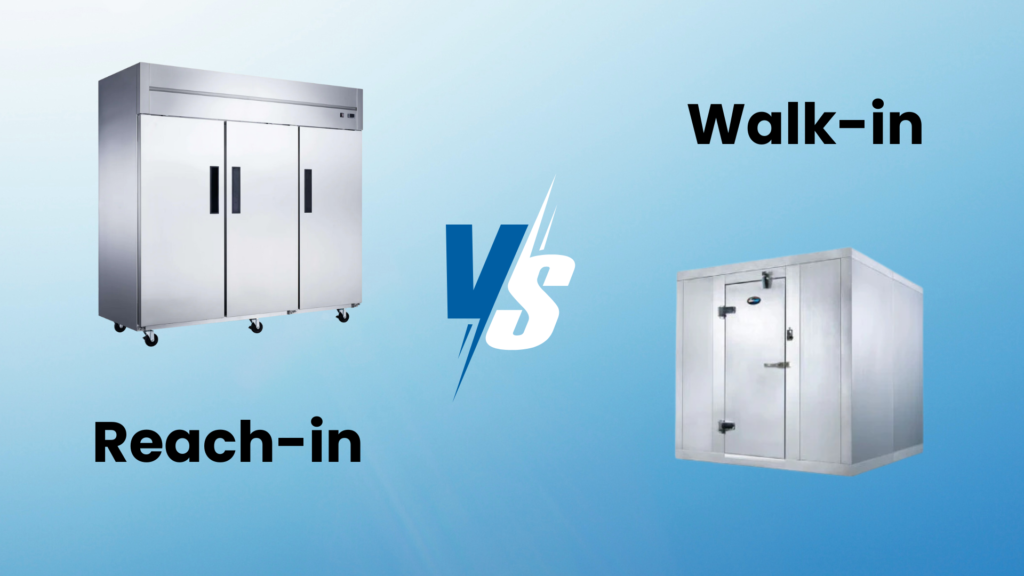
Choosing between a walk-in cooler and a reach-in refrigerator is one of the most consequential decisions a commercial kitchen operator can make. This choice affects not only storage capacity, but also workflow efficiency, food safety, energy consumption, long-term operating costs, and future scalability. While both refrigeration types serve the same fundamental purpose, they are designed for very different operational realities.
This guide breaks down the real differences between walk-in coolers and reach-in refrigerators, focusing on how each performs in day-to-day commercial use. By the end, you should have absolute clarity on which option aligns best with your kitchen’s size, volume, and growth plans.
Functional Differences
At the most basic level, the distinction between walk-in coolers and reach-in refrigerators comes down to scale and access, but the operational impact runs much deeper than that.
A walk-in cooler is a dedicated cold storage room that allows staff to physically enter the refrigerated space. This design supports bulk ingredient storage, palletized deliveries, and high-volume operations where large quantities of food need to be stored, rotated, and accessed throughout the day. Walk-ins are especially effective in kitchens that receive frequent deliveries or operate multiple stations simultaneously.
Reach-in refrigerators, by contrast, are upright or undercounter units designed for quick access to smaller quantities of product. They are typically positioned directly on the cook line or prep area, allowing staff to grab ingredients without stepping away from their station. This makes reach-ins ideal for speed and convenience, particularly in fast-paced environments with limited back-of-house space.
From a workflow perspective, walk-ins centralize storage. Ingredients are retrieved in batches, often during prep periods, and distributed to reach-ins or prep tables as needed. Reach-ins support immediacy but can become restrictive when volume increases. Overloaded reach-ins lead to airflow issues, inconsistent temperatures, and slower service.
In short, walk-ins optimize capacity and organization, while reach-ins optimize speed and proximity. Most high-performing kitchens eventually use both, but the starting point matters.
Space Requirements and Installation Considerations
Space planning is often the deciding factor, especially for existing restaurants or leased properties.
Reach-in refrigerators are relatively simple to deploy. Most models are self-contained, require only standard electrical connections, and can be installed in a matter of minutes. Their footprint is predictable, and they can be relocated if the kitchen layout changes. For operators with limited square footage or short lease terms, reach-ins offer flexibility and low commitment.
Walk-in coolers require a more deliberate approach. Installation involves insulated panels, a dedicated refrigeration system, and proper floor preparation. Ceiling height, door clearance, ventilation, and proximity to electrical and mechanical systems must all be considered. Outdoor walk-ins introduce additional requirements such as weatherproofing and structural pads.
However, the space investment of a walk-in often replaces multiple reach-ins. A single walk-in can free up valuable kitchen real estate by eliminating the need for several upright units scattered across the back of house. For new builds or major renovations, walk-ins are easier to integrate efficiently than retrofits.
The key question is not just “Do I have space?” but “How should this space work for me over the next five to ten years?”
Cost Breakdown
Upfront cost is where many operators stop their analysis, and that is where mistakes often begin.
Reach-in refrigerators have a lower initial price point. A single unit represents a manageable capital expense, making reach-ins attractive for startups and small operations. Installation costs are minimal, and replacement is straightforward if the unit fails.
Walk-in coolers require a higher upfront investment. Beyond the cooler itself, there are costs associated with installation, electrical work, and sometimes structural modifications. At first glance, this can feel prohibitive.
However, long-term operating costs tell a different story. Multiple reach-ins running simultaneously often consume more energy than a properly sized walk-in system. Maintenance costs also compound as the number of units increases. Each compressor, fan motor, and control system represents another potential failure point.
Walk-ins, when designed correctly, are more energy efficient per cubic foot of storage. They also simplify maintenance by consolidating refrigeration into a single system. Over time, especially in high-volume operations, walk-ins frequently prove to be the more economical choice despite the higher initial spend.
The real comparison is not one walk-in versus one reach-in, but one walk-in versus three or four reach-ins attempting to do the same job.
Best Use Cases by Business Type
Different businesses experience refrigeration needs very differently, and context matters more than general rules.
Full-service restaurants typically benefit from walk-in coolers due to diverse menus, high ingredient variety, and frequent deliveries. A walk-in supports bulk purchasing, better inventory rotation, and cleaner organization.
Fast-casual restaurants and quick-service concepts often rely more heavily on reach-ins placed near prep and service lines. Speed and space efficiency are priorities, and ingredient variety is usually narrower.
Bakeries often require both. Walk-ins are used for dough fermentation, bulk dairy storage, and flour-based ingredients, while reach-ins support finishing stations and display prep.
Grocery stores, delis, and specialty food retailers almost universally depend on walk-in refrigeration for back-of-house storage, supplemented by reach-ins or display cases for customer-facing access.
Cafes and coffee shops frequently operate successfully with reach-ins alone, especially when menus are limited and space is tight. However, growth often forces a reevaluation sooner than expected.
Matching the refrigeration type to the business model is more reliable than following industry averages.
Energy Efficiency, Maintenance, and Reliability
Refrigeration is one of the largest ongoing energy expenses in a commercial kitchen equipment, and efficiency should never be an afterthought.
Reach-ins cycle frequently due to constant door openings and smaller thermal mass. This makes them more sensitive to loading practices and ambient kitchen temperatures. Poor maintenance quickly leads to temperature fluctuations and compressor strain.
Walk-in coolers maintain temperature stability more effectively due to their size and insulation. While doors are opened less frequently, when they are opened, the temperature drop is more gradual and easier to recover. Modern walk-in systems also allow for remote condensers and more advanced control options, improving reliability.
From a maintenance standpoint, one well-maintained walk-in system is often easier and cheaper to service than several independent reach-ins. Preventive maintenance schedules are simpler, and downtime affects fewer components.
Reliability ultimately comes down to proper sizing, installation quality, and routine maintenance, but walk-ins tend to age more gracefully under heavy use.
How to Choose the Right Option for Your Kitchen
The right choice is rarely binary. Instead of asking which option is better, operators should ask which option fits their current operation without limiting future growth.
A reach-in refrigerator is the right choice when space is limited, volume is predictable, and flexibility is essential. A walk-in cooler is the right choice when storage needs are significant, inventory management matters, and operational efficiency is a priority.
Key questions to ask include:
How often do I receive deliveries?
How many menu items rely on refrigerated ingredients?
How quickly is my business growing?
Am I solving today’s problem or planning for tomorrow?
In many cases, the most efficient solution is a hybrid approach, using a walk-in for bulk storage and reach-ins for line access. Understanding the role each system plays is what separates functional kitchens from truly optimized ones.